So you can tell that I wasn't dicking around about that recommitment to this blog, I am posting again, in what I hope will be a new running feature in which I tell you what I think about the New York Times Book Review. For friendless book nerd, the New York Times Sunday Book Review is the most important thing that happens every week. It's got a lot going for it. It comes on Sunday, and what else are you going to do on Sunday? It combines book reviews, lists of best sellers to be indignant about, and, the piece de resistance, the Fun Essay About a Topic. This is the NYTBR equivalent of the New Yorker's Critic at Large pieces, which are basically little chunks of thinking out loud about books that are occasioned by Events. Lots of times, the Event is a biography or a movie or something. This week's fun Essay About a Topic is about a new translation of something, namely Kafka's first novel, Amerika. Adam Kirsch considers the weirdness of this, Kafka's first and unfinished novel, as the first spin of a spiral that "surveys the same spiritual territory but from a [progressively] more commanding height." As Adam Kirsch, who wrote this essay, notes, Amerika is the least commanding height; the Trial and the Castle would later encompass more of our guilt, and understand our complicity in a way that the more defensive Amerika fails to.
This Fun Essay About a Topic was a good one. As for the rest of the NYTBR, well, I will admit that this first week was not the best, and that I did not (ahem) technically read all of it. Or really any of it, apart from that thing about Amerika and the review of Downtown Owl by Chuck Klosterman, which failed to be totally excoriating and thus determined that I will end up reading Downtown Owl. Which leads me to want to say another thing about why the NYTBR on Sundays is so great: the reviews. What's so great about the reviews, you ask me, those are in every day excluding Saturdays! Well, I say, these aren't just any reviews. They are like the Judicial Branch reviews. Every day, Janet Maslin, Michiko, and those other guys show up lay down the book review laws. Then, once a week, in rolls the big shots, reviewing books that may or may not have been reviewed by the everyday guys, doing whatever they please. Interpreting the laws. So anyway, hopefully soon I will have more things to say about the reviews. But for now: don't necessarily avoid Downtown Owl.
Tuesday, January 6, 2009

Auld Lang Syne
And resume. Happy New Year, kinder! So, that was a long vacation, and I'm sorry. I have successfully navigated some claims on my time, and now we’re back: in the spirit of backness, I'm officially turning the page on Pnin (sorry, Pnin) and declaring a new book...at the bottom of this post (surely you all remember the heady early days of this blog in which I communicated mainly by e-mails that had 800 words of throat-clearing followed by the book pick at the end; and here we are again). Before I get to that, I want to say some things about another one that got away: our old pal Henry James.
Not the real Henry James, but David Lodge's Henry James, the fussy old failed playwright who is the going concern of Author, Author, a book of which I claimed that it was thin on top, and which I held out hopes that it would get portly in the middle. These are some hilarious jokes when one remembers that Henry James himself was both of those things, and because I am actually laughing right now as I type them for the second time, I can see why I am often lonely. Anyway, I read the rest of that book, along with most of Kafka's short stories, on a trip to visit my grandmother in Florida a few months ago, but only remembered to tell you more about them until just now. Oh well.
One of the reasons that I was originally fascinated by the idea of this book was because I liked Henry James and because I liked the sort of decoupage idea that a successful and established writer would want to plaster a different successful and established writer all over one of her novels. To this end, I bought Author Author and The Master of Petersburg and decided to get cracking. And then, best laid plans as you know, of course, and I wound up not reading them for a while. So here, belatedly, is what we have to say about: the Purloined Author.
Though, before going on, this is what C. Auguste Dupin has to say about a method for finding a purloined letter: “When I wish to find out how wise, or how stupid, or how good, or how wicked is anyone, or what are his thoughts at the moment, I fashion the expression of my face, as accurately as possible, in accordance with the expression of his, and then wait to see what thoughts or sentiments arise in my mind or heart as if to match or correspond with the expression.” That’s what Dupin learned from a schoolboy who hustled for marbles, and it set me to imagining Lodge fashioning the expression of James’s face, or the lightly bearded Coetzee fashioning the expression of the massively bearded Dostoevsky. But none of that happened in these books I read; the Master of Petersburg reads an awful lot like Disgrace, and Author, Author looks an awful lot like Changing Places. Neither book knocked my socks off; I don’t know if they would have, had one sounded more like Crime and Punishment and the other more like the Ambassadors. That may have been worse, actually, netting us a kind of limp parody or, god help us, something like the Oxen of the Sun chapter from Ulysses.
The Lodge book had a few moments that seemed like the explanations to jokes; at one point, his Henry tells his friend du Maurier that his cousin Minny, for whom he had stilted romantic feelings, had “a burning desire to do something great with her life.” Du Maurier responds: “Like Isabel Archer, in The Portrait of a Lady?” I cannot imagine a circumstance in which Henry James would ever need reminding whence Isabel Archer, and I cannot imagine a friend of his thinking that he needed such reminding. That is the problem with this guy, the protagonist of Author, Author: we frequently are reminded that he is Great Novelist Henry James, which gets irksome. It is as if people kept asking Hamlet if he felt melancholily Danish; to be part of a believable universe, it is better if that sort of tag is just assumed. This is not to say that the book is irrevocably scuttled; just occasionally bothersome. In fact, I enjoyed greatly the section in which James’s play opens miserably; its panoramic view (of other notables sitting in the audience) and its lack of Henry James proselytizing (all he does is fidget) made it an interesting portrait of an artist as his play flops.
The Dostoevsky of the Master of Petersburg is not constantly reminded of his Dostoevskiness, which is slightly odd given that unlike the events of Author, Author, the plot to which he’s purloined is almost entirely made up. It is built up out of some facts about a historical nihilist named Nechaev, some from Coetzee’s biography, and some from a suppressed chapter of Dostoevsky’s Demons. Out of this stew we get a peripatetic author, who gads about Petersburg thinking Dostoevsky things (beauty will save the world, gambling is great) in Coetzee’s short, present tense sentences. (For some reason, I can’t imagine the actual Dostoevsky abiding the historical present tense, by the way.) In both books, I found myself consistently wondering just why these authors had been impressed into protagonist duty, and unable to come up with much. Michiko Kakutani finished the Master of Petersburg “marveling at the waste of Mr. Coetzee’s copious talents on such an odd and unsatisfying enterprise.” I’m with her. Like the letter in Poe’s story, Dostoevsky seems to just sit available in the open – in his own writing – while Coetzee dismantles the tables all around him, searching for what’s really going on.
I don’t know if this spells the end for these other-writer books with which I thought I’d be so delighted; I’ll hold out hope for Anthony Burgess’s Nothing Like the Sun, about Shakespeare. But! In book club news, here we shift back to the safer territory of books about thinly disguised versions of their own authors, with: the Savage Detectives, by Roberto Bolano, a book that the part of me that pretends that I have Janet Maslin’s cell is shocked I haven’t read already. I have actually started it; it is fabulous. Expect fuller updates later in the week, as we begin a new and newly committed year of unpacking my library.
Friday, November 21, 2008
Proof that God Loves Us and Wants Us to Be Happy
Here are some things that have made me think, "I should get drunk immediately" in the last couple of months:
1) the Buffalo Bills win
2) the Buffalo Bills lose
3) the people on The Office seem too sad
4) the people on the Office seem too happy
5) Lord of the Rings seems too long
6) anything at all about the movie The Last Waltz
7) my parents
8) everyone at my workplace
So there is a sampling, undoubtedly not totally representative -- I have thought "I should get drunk immediately" way more than eight times in the last few months -- but a sampling that correctly and conspicuously fails to mention books. Which is a shocker, because most lists I make that have to do with anything at all end up being pretty book-intensive. However, most books that have to do with drinking end up either being cautionary -- don't get as drunk as these protagonists! -- and there has never been, say, the book equivalent of the Last Waltz.
Rick Moody wrote an essay on celestial music that is included in the Best American Essays 2008, which I have been reading at coffeeshops the last few days, and one of the things he mentions therein is that in heaven, they need no intoxicants. "In heaven," he says, "you have not fallen short, you are not in a condition of wanting, you are theoretically happy, and so you are not looking for the music or drugs or spirits to intoxicate you in any way." I think that, in books, we need no intoxicants either. To me, alcohol represents the victory of not-knowing over knowing: he who makes a beast of himself gets rid of the pain of being a man. Reading is the opposite, then, of intoxication: he who makes a reader of himself delays the pain of being a beast. To me, working through a piece of literature is the opposite -- but, I have to add, the equal -- of working through a bottle of gin: one puts me up higher, in a position to judge without caring, and the other puts me where I don't want to do anything but listen to Hall and Oates, in a position of caring without judging. Those two activities, I should note (judging w/o caring and vice versa) are not necessarily opposed, though: both reading (All Shall Be Well, and All Shall Be Well, and All Manner of Things Shall Be Well) and drinking (Michelob Ultra) have reminded me to remind my father that I love him. However, I only mentioned that after reading the book; after drinking all that Mich Ultra, all I did was start jabbering at him about progressive income tax and socialized health insurance. That is what I get for having, as the one book I like to read when drunk, Paul Krugman's The Conscience of a Liberal in my liquor cabinet. So I guess in the last analysis, as usual, books beats booze by a narrow margin.
Thursday, November 20, 2008
Hamlet's Buddy
So I have scaled another assault -- from the beginning -- on Elizabeth Royte's Garbage Land, and I like a lot, still. I read it on the stationary bike at the gym. But it still seems to me to suffer (if categorically, not specifically) from the almost piecemeal way in which the non-fiction characters are developed. It is better this time, at any rate, because I read the book in great swaths while on the bike, instead of in little nibbles while I wait at a toll or walk through the mall or watch tennis, in all of which situations I read the book the last go-round.
Anyway, I am reintroducing all of this because I was thinking about the idea of nonfiction characters, and what it is like to deal with people in writing who are not entirely open to us not because it is not especially material (the way that we are not vexed over what, say, what Captain Peleg was up to the whole time the Pequod was asea), but because they are real people, and because their chroniclers are prevented by the truth, not by convenience, from telling us everything they think. Natalie Zemon Davis's The Return of Martin Guerre, about a case of mistaken identity from the sixteenth century, is a fascinating piece of this kind of inscrutablilism: there is a real Martin, an impostor Martin, a Mrs. Guerre who seems to be okay with either of them, and eventually Montaigne throws his two cents in. But it is really hard to ever figure out just why anyone is does what they do the way they do it and not some other way; from five centuries out, these people -- who did not write much that we have down -- are some of history's mysteries. The people who run the waste services in Garbage Land are a little more annoying -- they are obfuscating, rather than inscrutable -- but they are similarly and wholly nonfiction, and of course: the Return of Martin Guerre and Garbage Land are both nonfiction books. But!
But, are there ever any people like that in fiction books? It seems like it may be unlikely: the characters in fiction are more likely to be inscrutable for a reason than for the general inscrutability of the world. I don't know much about Pierce Inverarity's real affiliation with the Tristero people, but that's because Pynchon wouldn't tell me, rather than that he couldn't. But one person stands out, from fictiondom, as the kind of hard to read, obfuscating, and piecemeal character we expect from real life and reasonable reports from real life: Horatio, Hamlet's buddy.
It is disappointing to remember, as we must, that we are much more like Horatio than we are ever like his friend. We are in fact more like Horatio than we are like most of the outsize characters in Hamlet (thank goodness, for most of them). There are more things in heaven and earth than are dreamt of in our philosophy. That has a lot to do with our philosophy --and Horatio's -- concerning itself mostly with a recalcitrant earth. Hamlet is a magnificent fiction, and can have to do with those other things. But is that simply because Horatio is a simpleton, or are his problems of confronting recalcitrance more like ours for another reason?
I think that Horatio has problems which remind us of our problems because, unlike any of the other characters in Hamlet -- unlike any of the characters I can think of anyplace, off the top of my head -- he is doing an enormous amount of work in our world: he is, at several critical junctures, ensuring that you and I do not lack information about Shakespeare's drama called Hamlet. Why does he hang out with those night watchmen of whom he is so skeptical? Does he really have nothing better to do than wander around graveyards with Hamlet saying things like "E'en so, my lord"? And, most bizarrely, why is he the one who tells the queen about how crazy Ophelia has become? That last one seems, to me, to be inexplicable -- except by thinking that Shakespeare has needed us to see what she has been up to, and thus to provide us with an inexplicable -- but dramatically unnoticeable -- link to the rest of the story. Horatio is an in, for us, to everything else that goes on in Hamlet, much as the bland san men in Royte's book (remember that one from the beginning of this post?) are an in into her meditations on garbage. But, unfortunately, they are part of the same boring real world as we are.
I don't know whether or not this has much bearing on the more ethereal examples of people becoming fictional (a topic close to my own personal heart), but I am willing to think on it.
Monday, October 6, 2008
Review Reviews
Do you guys know those ads that look like no one was trying, that show up at the bottom of websites when you search for free streaming football games? The all-text ads in blue that reflect an uncomfortable amount of knowledge about your Google searches, so that I keep seeing things like "Looking for singles in Pembroke, MA??" on my sidebar? Those things appear to be constructed with the same eye and attention to detail as the book review of the newspaper of Buffalo, NY (our fair city). Which, I think, is too bad.
I've been looking at majorish American cities' book sections in an attempt to see if anything comes close to the Times Book Review, which has the pole position by a lot. (I don't actually understand poles and the positions of cars relative to them, so I only assume that you can have the pole position by a lot). I liked the San Francisco Chronicle's section but it has more announcements and reportage than reviews. I like the one at the LA Times-- like its northbound statemate, both have a clean and colorful page setup. The one done by the Globe is ok, too, but has too much non-book stuff crowding it up. And then there's the one from Buffalo (our fair city), the place that accounts for the "majorish" instead of a major in the first sentence of this paragraph.
I will admit, that as a rabid partisan of the New York Times, and as a person who likes to quote Christ on the reception of important people in their own towns, that I figured that the Buffalo News's book section would be a good opportunity to exercise the muscles used for scoffing. But, I am an idiot, as you know. This reviews are quite good. They are not as voluminous as the ones at the Times but, well, obviors. They are quality assessments of the books under consideration, which I guess is exactly what you want from a review. But.
But, this is not a place I would go to three or four times every day (as I do NYT's Book Section, Bookforum, Bookslut, themillions and a few other booknerd places), and part of the reason is the failure to show a confidence that their readers care about books. This is something I have noticed not only in reading reviews at different places, but in talking to people who are usually casual readers. The greatness of the NYT Book Review, and of similarly great writing about books, is that they know that you, the reader, want to read something, and that reading is an important part of what you do. They know it. They don't have to sell you on reading a book of some kind instead of watching television; they want to tell you how the book they are talking about will shape itself into your life as a literary person.
So, Buffalo News: you've got the chops, go for it! Shine up your book review website, show a little confidence in yourselves and trust in your readers! They (I) are (am) out there!
Friday, October 3, 2008
Loudth
Are there any loud books? I have this idea that there are loud movies and quiet movies, and I am thinking about this idea because I am watching RockFest on VH1 Classic right now, and Guns 'n' Roses and Black Sabbath are certainly loud. Now, my first thought would be "no" because movies and bands make noise, and thus can be loud or not, and books, being made of wood, do not make noise unless you like bang them together. Even then, the noise will be unsatisfying and muted. But. I just went up into my room and yanked out a few things that might be contenders for loudness (incidentally, I hate the word loudness, and think it should be replaced with something classier like loudth, but loudth looks insane...I may try it for the duration of this post nevertheless).
So, first, Hemingway, who, if there is going to be SOUND DYNAMICS in fiction, has got to be among the quietest. He is the verses on Gigantic. His style is muted to the point that it gets made fun of for it. I guess that if books are quiet, Hemingway represents the bookiest books. There seems to be a studiousness about his work that is essential to it; try shouting a line from one of his stories at someone -- it will not work as well as it would with Mark Leyner, I guarantee it. Even a line that seems shoutable, like "Will you please please please please please please please stop talking" from "Hills Like White Elephants" sounds, relative to the world, wrapped in muslin.
So, first, Hemingway, who, if there is going to be SOUND DYNAMICS in fiction, has got to be among the quietest. He is the verses on Gigantic. His style is muted to the point that it gets made fun of for it. I guess that if books are quiet, Hemingway represents the bookiest books. There seems to be a studiousness about his work that is essential to it; try shouting a line from one of his stories at someone -- it will not work as well as it would with Mark Leyner, I guarantee it. Even a line that seems shoutable, like "Will you please please please please please please please stop talking" from "Hills Like White Elephants" sounds, relative to the world, wrapped in muslin.
Here are some guys whom I think might have some loudth, yanked from my bookshelves after a quick scan: Geoffrey Chaucer, John Barth, Norman Mailer. Let's see how they do.
Ok, here's Chaucer: "And whan I saugh he wolde nevere fyne/To reden on this cursed book al nyght/Al sodeynly thre leves have I plyght/Out of his book, right as he radde, and eke/I with my fest so took hym on the cheke/That in oure fyr he fil bakward adoun./And he up stirte as dooth a wood leoun,/And with his fest he smoot me on the heed/That in the floor I lay as I were deed." That's from the Wife of Bath's Prologue, and it maybe this seems louder to me than it might've because it is in verse, and thus more like music; and music, like the music I was talking about before, is for performance and thus can obviously be loud. Maybe the Wife of Bath is the thirteenth century Lita Ford. That bit about the fight between her fifth husband (wilcome the sixt, whenever he shal) can have some loudth because Chaucer is so good at rising, both in tempo and dynamically (both sentences start with "and"), and with his repitition (I think it is loudly, raucously hilarious that she says that both she and Symkyn hit each other with a fist). So Chaucer can get up there, mixing it up with some loudth and being funny. Anyone else?

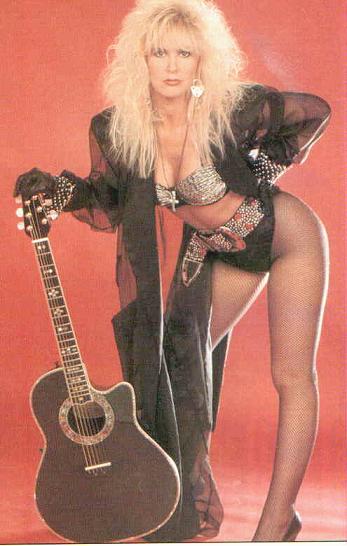
Barth, I think, is not really loud like Black Sabbath, but loud like this guy. He's not raucous; he's fast and showy. You don't get measured as quiet anywhere by stopping your story over and over to throw in an assessment of Freytag's triangle. If Chaucer drummed up some literate loudth by honing in on a musical description of a raucous event, Barth gets his by making noise. I think that is how a lot of postmodern writers, and Joyce work; Joyce is way loud, where most of his contemporaries are Hemingway-soft. In The Sot-Weed Factor he has a list of women calling one another whores in English and in French, and that's a lot of loud noise.
I think that one of the reasons that I love literature is that I am usually confident that when I like books, it is because they are good. When it comes to music, something that I am often enchanted by but probably do not love, I have no such confidence, because I can never tell if I like the song I like because it is good or dumb or both. The big clue for music is that the songs that I like that I tend to think are dumb, I only like when they're loud. So I think it's fitting, I guess, that the loudest author I can think of is Norman Mailer, one of the only writers whom I can't figure out as good, or dumb. Norman Mailer (at least the Norman Mailer of The Armies of the Night, which is the only of his books I know well) is the Ozzy Osbourne of American writing, except he's the Sharon Osbourne too because he does his own spin right along with his antics. Here he is, talking about the character of himself, insulted by Robert Lowell: "Mailer, looking back, thought bitter words he would not say: 'You, Lowell, beloved poet of many, what do you know of the dirt and the dark deliveries of the necessary?...What do you know about getting fat against your will and turning into a clown of an arriviste baron when you would rather be an eagle or a count, or rarest of all, some natural aristocrat from these damned democratic states." Next to this, in my copy, I wrote, "Seriously?" And looking back, I mean...seriously? This guy is a goofball. But he is a brilliant and glorious dumb goofball, and so he's the loudest man in American writing. As usual, I'm sure that there's something important about this, and unsure what. Something about this bombastic guy being loud and yet clearly wanting to be Hemingway, and being so full of noise but reminding me of music. Maybe if I expand my Mailer knowledge, I'll do myself a favor. I will check back with you guys when I see if I figure out the secret of music and literature and loudth in The Naked and the Dead.
Wednesday, October 1, 2008
Listmania
We like lists, right? The internet is the best place for lists, as we learn constantly here, here, and here. And that's not even getting into power rankings, which are one of the better things on the internet. And amazon, the place for books and internets, has a whole feature called Listmania. So. Do you guys want some lists? The problem I worry about is that maybe books aren't ridiculous enough for lists? Certainly not the ones on cracked. Maybe Mende-Siedlecki has some advice. If you're reading, Mende-Siedlecki, hit me with your best shot. Anyway, here is the inaugural list:
The Top Three Ways in Which I Have Made a Fool of Myself in Situations Involving Books and Girls
The Top Three Ways in Which I Have Made a Fool of Myself in Situations Involving Books and Girls
3. Here is #3: When I was in ninth grade, at all boys' school in Buffalo, I went to the library here in Lockport to find books about quantum mechanics. When I was in ninth and tenth grades, you should know, my buddy Hogan and I were obsessed with pop quantum mechanics for some reason. While there, I overheard the librarian showing some girl the books on euthanasia. Perfect situation to meet a girl, I thought, because I had never met any girls before. "You know," I murmured to the girl, while looking straight ahead, "euthanasia is Greek, for, beautiful, , death." I actually murmured that, and it actually had all those dumb commas' worth of pauses. The girl looked about as horrified as she should've. But I was not satisfied with etymology, and I decided to go in for the kill, with puns. "I myself" (when I was in ninth grade, I said things like "I myself") "am for euthanasia, because without them soon there'd be no adults in Asia."
In retrospect, this sheds light on my antipathy for the nonfiction section, maybe. Also, then I didn't talk to a girl for six years.
2. Seven years after I was in ninth grade, two of my friends and I got drunk and one of them decided to make some barbecue pulled pork sandwiches. So far, this story looks good, because drunk and sandwiches. However, this story also involves my Penguin Classics Edition of the Ambassadors by Henry James. My copy had a painting on it that had some people sitting by what I thought was a river. Or a lake. The girl whose boyfriend was in making sandwiches, for reasons I don't super remember or understand, claimed that it was in fact not a lake or a river, but a concrete fountain. I disagreed; she took the book away and stood on it for a few minutes. This is how people have fun where I went to school. Now, I especially loved this copy of the Ambassadors, and pleaded for it back; the girl agreed to surrender it, but only if, should the water turn out to be in a fountain, I would buy her lunch. I negotiated with this terrorist, and in the cruel light of the next morning, amid pulled pork sandwich detritus, that thing really did look like a fountain. Dammit. So, I had to pay for a lunch. And I felt forever disgraced in front of that copy of the Ambassadors. I still do, actually.
1. But because I am a recidivist, I have not stopped embarrassing myself in new and interesting ways with books and girls. This one gets top honors even though in this story, I am only embarrassed in front of myself and, now, the internet. And but so. I went to the bookstore the other day, and because I parked like a block away, I brought one of my books with me. And then. The cute girl in the bookstore said, "Could you leave that up here? They kind of get paranoid." So then was I sunk. You all remember, I've no doubt, my earlier claim that I was not going to buy any more books until I had no more than a hundred left to read. Well, I could hardly get my book I had been reading back, in front of that cute girl, without buying a book, too. So, here that claim's mettle was tested, and boy, did it fail. In fairness (to me) I did hover around the poetry section in the front, hoping that the cute girl would go on break or something before I had to collect my book in penury and retire in disgrace. But she stayed put. So I did what anyone who is morbidly concerned with what strangers think of them would do: I threw my policy on bookbuying to the wind, and picked up the Best American Essays 2008. Secret shame, secret overshare.
So there we have it, our first list. Although on review it is less of a list and more three barely related things that couldn't have been coddled into full posts on their own. Least publishable unit, I guess. But! Have you guys sorted your embarrassments into things with books? Have you any ideas for lists? Let me know! I don't pay for the ability for you people to comment to heat the whole neighborhood, you know.
Subscribe to:
Posts (Atom)