This is going to be a post against cool ideas. Now, in general, I am for cool ideas. They are often cool. A cartoon song about George Washington? That's a cool idea. Puppies at halftime during the super bowl is a cool idea. These are also both clearly the fruit of someone thinking "you know what would be cool?" and then making their cartoon or their halftime show. So, in most walks of life, cool ideas do good work. But not novels. I mean, novels are the one place, really, where just wanted to have a cool idea set forth just isn't going to cut it.
I started writing this post without really knowing why this was going to be true, but knowing that I was going to end up coming down on Downtown Owl for failing as a novel by being rather obviously a string of written episodes clearly inspired in their author by a series of cool ideas. Related but non-interlocking stories is a cool idea, and sets up early for a big convergent ending, which is a cool idea. Nicknames are a cool idea, and novels offer unchecked nicknaming range (it's almost only in novels that we find those guys with nicknames whose working is dependent on a nickname-last name hookup [I say that as a gut thing, especially since the only such nickname I can think off the top of my head is from a movie {Randall "Pink" Floyd}]). But none of these nicknames sound like anything that real humans would make up, and, more importantly, none of them seem especially revelatory about the characters whom they nickname. One guy is called the Dog Lover because he, uh, loves his dog; but at no point does his dog-loving stand in poignant counterpoint, or even poignant point to anything else that goes on in the novel. One guy -- one of our main guys-- is named Mitch Hrlicka, and is called Vanna, because his football coach thought his name needed more vowels. That is clever enough -- except it seems like cleverness cheaply bought, because, of course, the same author who made up the nickname actually made up the nickedname, too.
I think that one of the opposites of this is the sublimely ridiculous Armies of the Night, by Norman Mailer, where Mailer talks at huge length about his own involvement in a march on the Pentagon to protest the Vietnam War. He keeps yammering about Mailer's long suffering, and the Huge Historical Importance of everything he does. On paper, it is irredeemably lame: writing a novel more or less explicitly to justify a certain thing you've done is like the anti-cool idea. But Mailer has two things that I think are at the core of what good novels need: he has an undeniably magnificent sense of literary style, and he has an unswerving sense of commitment to writing these things down with that style, a sort of ineffable sense that he, Mailer, is absolutely compelled to write this book (this sense of compulsion is something that I keep invoking to defend Bolaño's so thinly veiling the version of himself [Belano] who stars in the Savage Detectives). What Downtown Owl ends up suffering from is a decent but not overwhelming style -- a style that's really most at home with observational stand-up comedians and a pre-backlash Malcolm Gladwell-- and an overarching sense not of compulsion, but of coolness.
This may not be a thing that causes concern for everyone, I have just thought; but to me, what makes these two shortcomings (and shortcomings may be putting it strongly; cool ideas and hey-what's-the-deal-with-this style make some brilliant essays, for sure) so galling to me is that they seem to come short of justifying the invention of the world of Downtown Owl. Why this might not concern everyone, is that I am well aware that I more than most put heavy stock in fictional people. I care about them deeply, and want to care about them almost as autocratic beings. When the characters in a book like this -- and a book that, in its final third, is clearly set up to inspire some kind of cosmic pathos -- seem to have been born not out of a compulsion to create people on the behalf of their author, but out of a desire to serve cool ideas, it ends up making me feel disappointed.
So that's that. According to the BS report with Bill Simmons, Chuck Klosterman's next book will be essays; I will almost definitely buy it in hardcover. And leave my highly exacting needs for novels to somebody else. Somebody called maybe, Bolaño? More on him tomorrow.
Showing posts with label Norman Mailer. Show all posts
Showing posts with label Norman Mailer. Show all posts
Wednesday, February 18, 2009

Monday, January 26, 2009
Time in a Bottle
Ulises Lima and Arturo Belano have made it to Europe, at the point I've gotten to thus far, and Ulises Lima farther than that, to Tel Aviv. Today I want to talk a little bit about how the oral history structure of the book is working, and how that contributes to the way, discussed earlier, in which Our Guys are got at peripherally, rather than head-on. First a note on what it is not: every once in a while, when someone says something particularly nice about Arturo Belano, I am tempted to think what I have been told is sometimes thought, viz., this looks like a way for Bolaño to sneak in some nice things about himself, like Norman Mailer's huffing and puffing about "Norman Mailer" in the Armies of the Night, or anything that has to do with Agent Michael Scarn. But I don't think so. I don't have a really definite reason for why I don't think so; maybe it's just because I haven't read the introduction, and don't yet know how narrowly or widely the life of Belano differs from the life of Bolaño.
But I mention this because it is, critically, not that displacement strategy which I think is served by the oral history. Now, to be disclose-y, I am not what you'd call an oral history expert; the only other one I have read is Rant by Chuck Palahniuk which, like the Savage Detectives, is totally made up. What I think Bolaño is doing, and doing better than Palahniuk does in Rant, is to create different time signatures. The passages that made up Rant tended to be roughly the same size, and passed not chronologically as far as the events related were concerned, but seemed presented chronologically with their telling. Not so with the Savage Detectives. So far, I have sorted out three kinds of passage: one, the self-contained stories, like Auxilio Lacouture on her activities during '68 or Norman Bolzman talking about Ulises Lima in Tel Aviv; then, the running commentaries that keep pace with Our Guys, like those by Quim Font and his daughters, or Luis Sebastian Rosado, whose years of comment keep ticking up; and then, by itself, the very long description of an encounter with Arturo Belano and Felipe Muller that we get, alway from 1976, from Amadeo Salvatierra. That last one, in particular, is probably one on which to keep an eye.
As usual, these ideas are inchoate, and consist mostly of notes and very little of judgments (beyond the fact that, given that I am now reading this book at a rather fast pace, they appear to be working). But so. There's something about the Savage Detectives to bear in mind. Until to-morrow, friends.
But I mention this because it is, critically, not that displacement strategy which I think is served by the oral history. Now, to be disclose-y, I am not what you'd call an oral history expert; the only other one I have read is Rant by Chuck Palahniuk which, like the Savage Detectives, is totally made up. What I think Bolaño is doing, and doing better than Palahniuk does in Rant, is to create different time signatures. The passages that made up Rant tended to be roughly the same size, and passed not chronologically as far as the events related were concerned, but seemed presented chronologically with their telling. Not so with the Savage Detectives. So far, I have sorted out three kinds of passage: one, the self-contained stories, like Auxilio Lacouture on her activities during '68 or Norman Bolzman talking about Ulises Lima in Tel Aviv; then, the running commentaries that keep pace with Our Guys, like those by Quim Font and his daughters, or Luis Sebastian Rosado, whose years of comment keep ticking up; and then, by itself, the very long description of an encounter with Arturo Belano and Felipe Muller that we get, alway from 1976, from Amadeo Salvatierra. That last one, in particular, is probably one on which to keep an eye.
As usual, these ideas are inchoate, and consist mostly of notes and very little of judgments (beyond the fact that, given that I am now reading this book at a rather fast pace, they appear to be working). But so. There's something about the Savage Detectives to bear in mind. Until to-morrow, friends.
Friday, October 3, 2008
Loudth
Are there any loud books? I have this idea that there are loud movies and quiet movies, and I am thinking about this idea because I am watching RockFest on VH1 Classic right now, and Guns 'n' Roses and Black Sabbath are certainly loud. Now, my first thought would be "no" because movies and bands make noise, and thus can be loud or not, and books, being made of wood, do not make noise unless you like bang them together. Even then, the noise will be unsatisfying and muted. But. I just went up into my room and yanked out a few things that might be contenders for loudness (incidentally, I hate the word loudness, and think it should be replaced with something classier like loudth, but loudth looks insane...I may try it for the duration of this post nevertheless).
So, first, Hemingway, who, if there is going to be SOUND DYNAMICS in fiction, has got to be among the quietest. He is the verses on Gigantic. His style is muted to the point that it gets made fun of for it. I guess that if books are quiet, Hemingway represents the bookiest books. There seems to be a studiousness about his work that is essential to it; try shouting a line from one of his stories at someone -- it will not work as well as it would with Mark Leyner, I guarantee it. Even a line that seems shoutable, like "Will you please please please please please please please stop talking" from "Hills Like White Elephants" sounds, relative to the world, wrapped in muslin.
So, first, Hemingway, who, if there is going to be SOUND DYNAMICS in fiction, has got to be among the quietest. He is the verses on Gigantic. His style is muted to the point that it gets made fun of for it. I guess that if books are quiet, Hemingway represents the bookiest books. There seems to be a studiousness about his work that is essential to it; try shouting a line from one of his stories at someone -- it will not work as well as it would with Mark Leyner, I guarantee it. Even a line that seems shoutable, like "Will you please please please please please please please stop talking" from "Hills Like White Elephants" sounds, relative to the world, wrapped in muslin.
Here are some guys whom I think might have some loudth, yanked from my bookshelves after a quick scan: Geoffrey Chaucer, John Barth, Norman Mailer. Let's see how they do.
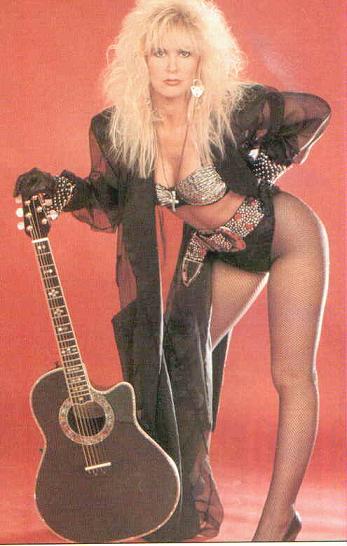
Ok, here's Chaucer: "And whan I saugh he wolde nevere fyne/To reden on this cursed book al nyght/Al sodeynly thre leves have I plyght/Out of his book, right as he radde, and eke/I with my fest so took hym on the cheke/That in oure fyr he fil bakward adoun./And he up stirte as dooth a wood leoun,/And with his fest he smoot me on the heed/That in the floor I lay as I were deed." That's from the Wife of Bath's Prologue, and it maybe this seems louder to me than it might've because it is in verse, and thus more like music; and music, like the music I was talking about before, is for performance and thus can obviously be loud. Maybe the Wife of Bath is the thirteenth century Lita Ford. That bit about the fight between her fifth husband (wilcome the sixt, whenever he shal) can have some loudth because Chaucer is so good at rising, both in tempo and dynamically (both sentences start with "and"), and with his repitition (I think it is loudly, raucously hilarious that she says that both she and Symkyn hit each other with a fist). So Chaucer can get up there, mixing it up with some loudth and being funny. Anyone else?

Barth, I think, is not really loud like Black Sabbath, but loud like this guy. He's not raucous; he's fast and showy. You don't get measured as quiet anywhere by stopping your story over and over to throw in an assessment of Freytag's triangle. If Chaucer drummed up some literate loudth by honing in on a musical description of a raucous event, Barth gets his by making noise. I think that is how a lot of postmodern writers, and Joyce work; Joyce is way loud, where most of his contemporaries are Hemingway-soft. In The Sot-Weed Factor he has a list of women calling one another whores in English and in French, and that's a lot of loud noise.
I think that one of the reasons that I love literature is that I am usually confident that when I like books, it is because they are good. When it comes to music, something that I am often enchanted by but probably do not love, I have no such confidence, because I can never tell if I like the song I like because it is good or dumb or both. The big clue for music is that the songs that I like that I tend to think are dumb, I only like when they're loud. So I think it's fitting, I guess, that the loudest author I can think of is Norman Mailer, one of the only writers whom I can't figure out as good, or dumb. Norman Mailer (at least the Norman Mailer of The Armies of the Night, which is the only of his books I know well) is the Ozzy Osbourne of American writing, except he's the Sharon Osbourne too because he does his own spin right along with his antics. Here he is, talking about the character of himself, insulted by Robert Lowell: "Mailer, looking back, thought bitter words he would not say: 'You, Lowell, beloved poet of many, what do you know of the dirt and the dark deliveries of the necessary?...What do you know about getting fat against your will and turning into a clown of an arriviste baron when you would rather be an eagle or a count, or rarest of all, some natural aristocrat from these damned democratic states." Next to this, in my copy, I wrote, "Seriously?" And looking back, I mean...seriously? This guy is a goofball. But he is a brilliant and glorious dumb goofball, and so he's the loudest man in American writing. As usual, I'm sure that there's something important about this, and unsure what. Something about this bombastic guy being loud and yet clearly wanting to be Hemingway, and being so full of noise but reminding me of music. Maybe if I expand my Mailer knowledge, I'll do myself a favor. I will check back with you guys when I see if I figure out the secret of music and literature and loudth in The Naked and the Dead.
Subscribe to:
Posts (Atom)