I think this is ok because they have already published this test. What I am about to share with you comes from the practice GRE in English Literature currently available from ETS, which I took this morning, and which, when not-yet-published, is protected by draconian, but usually understandable, security measures. When you see this question, you will think, along with me, that this kind of crackdown is unwarranted if it is going to deny the masses access to things like this. Those who would give up essential liberty to purchase a little temporary safety, deserve neither liberty nor safety.
Anyway, the highlight of the ETS's practice GRE:
Q. "'Are you not happy in Hertfordshire, Mr. Raskolnikov?' asked Elizabeth. 'Would you be happy,' he replied, 'if you had killed a miserable pawnbroker?' 'How easily may a bad habit be formed!' cried Elizabeth. and with this in mind, though she hoped he was not in earnest, she very soon afterwards took leave of him."
Which of the following titles would be most appropriate for a work containing this passage?
(a) Murder at Thirteen Rue de Toot
(b) Elizabeth and Anna Kremlina
(c) The Importance of Being Elizabeth
(d) Pride and Punishment
(e) The Golden Fawn
The Crow, a psychology major, guessed E.
Wednesday, April 9, 2008

The Companionship of the Long Distance Critic
This has become, by now, older than old news, and its position on the mighty Most E-Mailed List at the Times has of course been overtaken and overtaken again. Regardless, a promise is a promise, and here are: my polled, wildly unscientific, rhapsodic observations on the New York Times essay entitled, “It’s Not You, It’s Your Books.”
This essay begins with an anecdote, and then zooms out with the claim “We’ve all been there.” Where we’ve all been, supposedly, is the chilling moment when one realizes that his or her putative inamorato/a has atrocious taste in literature. This seems, though, to be something of a straw man. Virtually no one asked in my wildly unscientific poll had “been there”, and even the people in the Times piece seemed largely to think that shared literary taste wasn’t such a big deal. Love could often conquer all. Even people who seemed to think that books played a role in determining compatibility, such as the psychiatrist Anna Fels quoted in the piece, thought they did so mainly as a Rorschach test, as an index of what sort of person we are dealing with (viz., people who read Proust for fun are just different from people who read James Patterson for fun, or who don’t read at all).
What I thought was interesting about the article (apart from the Jessa Crispin quote, which was, I thought, by far the bright spot) was that everyone seemed to be in accord that there are fundamental persons leading bright romantic lives here, and that those fundamental persons would be cheapened somehow if their books they were to be judged. It is as if approving someone’s love of Richard Powers is similar to approving someone’s perfect hairline, or shying away from an Ayn Rand fan is like denying the possibility of the Ayn Rand fan’s inner beauty. The delicate self is somewhere, like an ear of corn, ensconced in a husk of tastes which we are to overlook. What is meant to be important, I suppose, is the corn.
And so it is. Notice that the only people toward whom those interviewed in the article tend to deny their sympathy to are the ones that are either totally helpless (the ones who liked Ayn Rand or Marley and Me) or the ones who try too hard to telegraph whatever it is that they’ve been reading. Here’s Northrop Frye:
“The original experience [of literature] is like the direct vision of color, or the direct sensation of heat or cold, that physics ‘explains’ in what, from the point of view of the experience itself, is a quite irrelevant way.” (Anatomy of Criticism, 27)
What we object to in this discussion is the idea that literature has been press-ganged into some advertising function, and we are as loath to be such advertisers as we are to be caught doing it ourselves. The original experience is to be left alone, such that talking about books is either left off or achieves the attitude less of shared experience than of work. The Old Crow was wise enough to clue me into this work attitude given to some literary discussion; the Shadow Correspondent informs me that while books must remain essentially private, inviolate, movies can take their place as shared cultural currency for romantics. (The Crow also points out that shared film tastes are important for tactical, if not strategic reasons).
I believe, then, that the reason people do not want to have their literary tastes used as a Rorschach test, by which others may judge their sensitivity or seriousness or whatever, is that they want to hold onto their own idiosyncratic readings as the way in which they assess their own selves. To make the preceding corn metaphor ridiculous, it is as the corn is happy to present its husk however it wishes, but needs literature to maintain its own understanding, of itself, as its own ear of corn. We ask that our commitments to literature be judged superficially (and receive those who do not do so as showboaters) when we fear the reckoning that we would have to give ourselves of those commitments. Or, I do anyway. Literature itself, and dealing with literature itself, is a lonely business, just as looking at vibrant flowers or sunsets, or feeling pleasant in front of a fire is an essentially lonely business. Deep down, what-it-is-like-to-read is an epiphenomenon, one available only to the person experiencing it, and shared only with the book itself.
This idiosyncratic power of literature seems to explain also the common reaction that people have of just hoping that their potential romantic quarry has read at all; it is as far as you can go toward shared literary experience to insist that someone has been in similar conditions (ie, read a book for fun). A person can’t know whether someone else has been alone with a book in the same way as they have, so the best they can do is to hope that that other person also knows how to be alone properly. As the Times notes, this can lead to infelicitous pairings; they cite the (alleged) possibility of one half of a couple identifying with Gilbert Osmond and one half with Isabel Archer which, I mean, have you read Portrait of a Lady? Someone who identifies with Gilbert Osmond is going to have bigger troubles than his taste in early James.
Criticism, incidentally, can speak for itself in a way in which literature cannot. That will be the object of my next wildly unscientific survey. Can your relationship survive competing commitments to Paul de Man and William Empson? Find out next time, on unpacking my library.
This essay begins with an anecdote, and then zooms out with the claim “We’ve all been there.” Where we’ve all been, supposedly, is the chilling moment when one realizes that his or her putative inamorato/a has atrocious taste in literature. This seems, though, to be something of a straw man. Virtually no one asked in my wildly unscientific poll had “been there”, and even the people in the Times piece seemed largely to think that shared literary taste wasn’t such a big deal. Love could often conquer all. Even people who seemed to think that books played a role in determining compatibility, such as the psychiatrist Anna Fels quoted in the piece, thought they did so mainly as a Rorschach test, as an index of what sort of person we are dealing with (viz., people who read Proust for fun are just different from people who read James Patterson for fun, or who don’t read at all).

What I thought was interesting about the article (apart from the Jessa Crispin quote, which was, I thought, by far the bright spot) was that everyone seemed to be in accord that there are fundamental persons leading bright romantic lives here, and that those fundamental persons would be cheapened somehow if their books they were to be judged. It is as if approving someone’s love of Richard Powers is similar to approving someone’s perfect hairline, or shying away from an Ayn Rand fan is like denying the possibility of the Ayn Rand fan’s inner beauty. The delicate self is somewhere, like an ear of corn, ensconced in a husk of tastes which we are to overlook. What is meant to be important, I suppose, is the corn.
And so it is. Notice that the only people toward whom those interviewed in the article tend to deny their sympathy to are the ones that are either totally helpless (the ones who liked Ayn Rand or Marley and Me) or the ones who try too hard to telegraph whatever it is that they’ve been reading. Here’s Northrop Frye:
“The original experience [of literature] is like the direct vision of color, or the direct sensation of heat or cold, that physics ‘explains’ in what, from the point of view of the experience itself, is a quite irrelevant way.” (Anatomy of Criticism, 27)
What we object to in this discussion is the idea that literature has been press-ganged into some advertising function, and we are as loath to be such advertisers as we are to be caught doing it ourselves. The original experience is to be left alone, such that talking about books is either left off or achieves the attitude less of shared experience than of work. The Old Crow was wise enough to clue me into this work attitude given to some literary discussion; the Shadow Correspondent informs me that while books must remain essentially private, inviolate, movies can take their place as shared cultural currency for romantics. (The Crow also points out that shared film tastes are important for tactical, if not strategic reasons).


I believe, then, that the reason people do not want to have their literary tastes used as a Rorschach test, by which others may judge their sensitivity or seriousness or whatever, is that they want to hold onto their own idiosyncratic readings as the way in which they assess their own selves. To make the preceding corn metaphor ridiculous, it is as the corn is happy to present its husk however it wishes, but needs literature to maintain its own understanding, of itself, as its own ear of corn. We ask that our commitments to literature be judged superficially (and receive those who do not do so as showboaters) when we fear the reckoning that we would have to give ourselves of those commitments. Or, I do anyway. Literature itself, and dealing with literature itself, is a lonely business, just as looking at vibrant flowers or sunsets, or feeling pleasant in front of a fire is an essentially lonely business. Deep down, what-it-is-like-to-read is an epiphenomenon, one available only to the person experiencing it, and shared only with the book itself.
This idiosyncratic power of literature seems to explain also the common reaction that people have of just hoping that their potential romantic quarry has read at all; it is as far as you can go toward shared literary experience to insist that someone has been in similar conditions (ie, read a book for fun). A person can’t know whether someone else has been alone with a book in the same way as they have, so the best they can do is to hope that that other person also knows how to be alone properly. As the Times notes, this can lead to infelicitous pairings; they cite the (alleged) possibility of one half of a couple identifying with Gilbert Osmond and one half with Isabel Archer which, I mean, have you read Portrait of a Lady? Someone who identifies with Gilbert Osmond is going to have bigger troubles than his taste in early James.

Criticism, incidentally, can speak for itself in a way in which literature cannot. That will be the object of my next wildly unscientific survey. Can your relationship survive competing commitments to Paul de Man and William Empson? Find out next time, on unpacking my library.
Sunday, April 6, 2008
Friends and Pronouns
Last night I wound up staying up until three o’clock in the morning to read the last hundred and eighty pages of a book I had been reading for a week or so. That book is called Then We Came to the End, by Joshua Ferris. The decision to stay up and read was a good one for three reasons.
1. The book was tremendous.
2. At one point, the man who once cost our softball team the championship with four errors in one inning IM’d me to tell me his new favorite song is by Miley Cyrus, and
3. Our Friend Blake IM’d me to tell me some of the rhymes he’s been working on, including a gem about exposing prose and staying poetic.
All in all, good decision by me to stay up. And since few books have ever made me stay up to the bitter end like this, and probably none with a similar distance to the goal line starting out (wait, one) – I figured I’d toss a recommendation/review out there on the airwaves.
So: the book is called Then We Came to the End, and it comes outfitted with one of those gimmicks that gets talked about but then isn’t really gimmicky in the book. This one’s is that it is told almost entirely in the first person plural (the first line is “We were fractious and overpaid”). At no point is there a single narrative persona chiseled out: the “we” speaks for the dozen or so employees at a Chicago ad agency during the economic downturn that took up the first couple quarters of fiscal 2001. There is downsizing; there are relatively mundane subplots; and there is commentary, which is snarkily funny and endearingly small. Most reviews I’ve seen of this novel mention one or two examples of these antipodes of office conversation; my personal favorite is that the office’s loser, a guy who calls his trips to the men’s room “a visit with Mr. B.”, gets tasked with an ad project for breast cancer awareness and gets some help from his father.
“Jim Jackers spent his lunch hour in the waiting room of the oncology ward at Rush-Presbyterian surrounded by some very sick people…Jim’s father sold medical equipment, and when Jim told him of his recent project, he contacted an oncologist on his son’s behalf and told Jim that the doctor was willing to speak with him. Jim wanted to talk to the doctor in the hopes of gaining the insight necessary to arrive at the winning concept for the fund-raiser, but at that particular hour the doctor proved too busy to spare any time, so Jim thanked the nurse and returned to his office.” (Ferris, 164)
We would all do well to remember that even these, the least of even our literary brethren, have fathers doing more than they can to give their sons more than they deserve.
That passage is dead on in its capture of what exactly it sounds like to be told a story, and the entire novel (almost) works that way. It’s been noted that it is difficult to really root against first-person narrators, even skeezoids like Humbert Humbert and Alex from A Clockwork Orange. Hearing them talk right to you can make you feel like a co-conspirator. Ferris’s “we” strategy goes one further: these people seem like your friends. Coworkers are more like book characters than, say, your parents are, so it is a good fit. It is also a task totally within the powers of the novel, to make us know these imaginary men and women as much as we know our coworkers. A while ago, I said some stuff about Emmas, and looking back, I don’t super know what I was talking about. However: one of the points I think I was trying to make there seem to be some novels that take a certain thing as their point of inquiry, and others that seem to have more high-concept or supposedly artistic points to make (Nabokov called Madame Bovary “prose doing what poetry is supposed to do”). Then We Came to the End is a “certain-thing” sort of novel: it throws life in an office under its merry observation apparatus and provides an unsentimental appreciation, a thing that I think is rare but to be valued. This is kind of vague; I do not want to talk about what the (almost) end of the novel is like, when it presents its sort of summing-up of what it has appreciated, because I think that would ruin the slow realization, at the end of the book, of just what end we’ve come to, and that by itself is worth the reading of the book.
Twice up there I said “(almost)”, because not quite all the book is told like a water cooler story, and there is a kind of epilogue after the stunning and beautiful close to the book proper. As if this book, providing me with imaginary friends at three in the morning, needed more for me to love it: the epilogue features the book’s nerdy writer character having achieved success and giving a reading…of the one non-water-cooler-story part of the book, which we have read about a hundred and fifty pages ago. Talk about my wheelhouse! That was mostly just a cherry on top, but I thought it warranted mentioning.
This book was on my radar as part of my plan to read all ten of the Times’s picks for best books of 2007, but it was also recommended by my ex-boss at the bookstore where I work. Since I have declared a cap on pages of unread book allowed in my house, finishing it clears up some room with which I am going to pick up The Emperor’s Children by Claire Messud, a book that is also about like in These Postmillennial United States, and which was recommended by an ex-professor of mine at the college where I studied. If you don’t think I am trying to come up with some kind of Recommendation Bracket to make noise about for the coming months, well then, have we actually met?
Up (possibly tomorrow): a belated forum on Papercuts, romance, and teh litz.
1. The book was tremendous.
2. At one point, the man who once cost our softball team the championship with four errors in one inning IM’d me to tell me his new favorite song is by Miley Cyrus, and
3. Our Friend Blake IM’d me to tell me some of the rhymes he’s been working on, including a gem about exposing prose and staying poetic.
All in all, good decision by me to stay up. And since few books have ever made me stay up to the bitter end like this, and probably none with a similar distance to the goal line starting out (wait, one) – I figured I’d toss a recommendation/review out there on the airwaves.
So: the book is called Then We Came to the End, and it comes outfitted with one of those gimmicks that gets talked about but then isn’t really gimmicky in the book. This one’s is that it is told almost entirely in the first person plural (the first line is “We were fractious and overpaid”). At no point is there a single narrative persona chiseled out: the “we” speaks for the dozen or so employees at a Chicago ad agency during the economic downturn that took up the first couple quarters of fiscal 2001. There is downsizing; there are relatively mundane subplots; and there is commentary, which is snarkily funny and endearingly small. Most reviews I’ve seen of this novel mention one or two examples of these antipodes of office conversation; my personal favorite is that the office’s loser, a guy who calls his trips to the men’s room “a visit with Mr. B.”, gets tasked with an ad project for breast cancer awareness and gets some help from his father.
“Jim Jackers spent his lunch hour in the waiting room of the oncology ward at Rush-Presbyterian surrounded by some very sick people…Jim’s father sold medical equipment, and when Jim told him of his recent project, he contacted an oncologist on his son’s behalf and told Jim that the doctor was willing to speak with him. Jim wanted to talk to the doctor in the hopes of gaining the insight necessary to arrive at the winning concept for the fund-raiser, but at that particular hour the doctor proved too busy to spare any time, so Jim thanked the nurse and returned to his office.” (Ferris, 164)
We would all do well to remember that even these, the least of even our literary brethren, have fathers doing more than they can to give their sons more than they deserve.
That passage is dead on in its capture of what exactly it sounds like to be told a story, and the entire novel (almost) works that way. It’s been noted that it is difficult to really root against first-person narrators, even skeezoids like Humbert Humbert and Alex from A Clockwork Orange. Hearing them talk right to you can make you feel like a co-conspirator. Ferris’s “we” strategy goes one further: these people seem like your friends. Coworkers are more like book characters than, say, your parents are, so it is a good fit. It is also a task totally within the powers of the novel, to make us know these imaginary men and women as much as we know our coworkers. A while ago, I said some stuff about Emmas, and looking back, I don’t super know what I was talking about. However: one of the points I think I was trying to make there seem to be some novels that take a certain thing as their point of inquiry, and others that seem to have more high-concept or supposedly artistic points to make (Nabokov called Madame Bovary “prose doing what poetry is supposed to do”). Then We Came to the End is a “certain-thing” sort of novel: it throws life in an office under its merry observation apparatus and provides an unsentimental appreciation, a thing that I think is rare but to be valued. This is kind of vague; I do not want to talk about what the (almost) end of the novel is like, when it presents its sort of summing-up of what it has appreciated, because I think that would ruin the slow realization, at the end of the book, of just what end we’ve come to, and that by itself is worth the reading of the book.
Twice up there I said “(almost)”, because not quite all the book is told like a water cooler story, and there is a kind of epilogue after the stunning and beautiful close to the book proper. As if this book, providing me with imaginary friends at three in the morning, needed more for me to love it: the epilogue features the book’s nerdy writer character having achieved success and giving a reading…of the one non-water-cooler-story part of the book, which we have read about a hundred and fifty pages ago. Talk about my wheelhouse! That was mostly just a cherry on top, but I thought it warranted mentioning.
This book was on my radar as part of my plan to read all ten of the Times’s picks for best books of 2007, but it was also recommended by my ex-boss at the bookstore where I work. Since I have declared a cap on pages of unread book allowed in my house, finishing it clears up some room with which I am going to pick up The Emperor’s Children by Claire Messud, a book that is also about like in These Postmillennial United States, and which was recommended by an ex-professor of mine at the college where I studied. If you don’t think I am trying to come up with some kind of Recommendation Bracket to make noise about for the coming months, well then, have we actually met?
Up (possibly tomorrow): a belated forum on Papercuts, romance, and teh litz.
Tuesday, April 1, 2008
Poor Ty Cobb's Had an Accident -- So Might You All
Baseball has started for real and for earnest now, and today was an off day for my new team (sorry, Molly and John). However, NESN has my back, and I am watching my old team as we speak. The literary benefits and connections of baseball are ancient and storied, and attract both those you'd expect (George Will) and those who, not so much (transgressive women's blog Jezebel.com). This blog, as the two of you who read it know, loves baseball. Here are some thoughts on baseball as it has resurged to its proper place in my life, and the (of course) bookish implications of baseball season.
My uncle's stepdad Wes told us the other day that he had seen a BBC telecast of Wimbledon back in the day, and that it was astonishing for its quietness -- they just shut up and let the tennis players play tennis. While it's true that there is a lot of commentator noise in all sports presentations, baseball is a special one for the amount of talking (rather than reporting) it generates (as that Jezebel post notes, "conversation is not only possible but encouraged"). Since the game isn't timed, you have lots of time to just sit around and talk about it. My soccer-loving friend Nils claims some statistic about how the ball is actually in play for about six minutes of the two and a half hours needed for a baseball game proper. Nils bemoaned this because he is from South Africa and only ever thinks about soccer, when the ball is in play for however many minutes they feel like should constitute that soccer game. However, all that down time means that there is plenty of time for talk -- and, just from watching the last few days, it is the chunks of language that bounce around baseball games that have the most comfortable familiarity to them, the things that make me most satisfied that the best time of the year has really showed up once again.
Someday, I will write on here what I think of the Major League Baseball Rulebook. I wanted to make the MLB Rulebook an entry in the Book Club, but people said that no one else would ever read it, that that was silly. Luckily, I have been eased of such responsibilities by the fact that no one reads the books except for me. So someday, probably in June, I will announce the Rulebook as the book club pick and those of you who don't like it may resign and get all your dues money back. Whatever I say about the stylistic pyromania and majesty on display in the MLB Rulebook, bear this in mind: it is the total opposite of what I'm about to say about baseball words. A batter "works a count". A team has "double-barreled action" in the bullpen. A starter has "done everything they've asked him to do". "Free baseball" for extra innings. In the real world, this is cant. It is stuff that gets said so often it doesn't really mean anything, and in the real world it is obnoxious. But in baseball, as teams change (they're not even the Devil Rays anymore!) and players are revealed to be more and more embarrassing as athletes and human beings, the cant -- the dreck -- is what shines on. I grinned four or five times watching two teams I didn't care about at all, because Jon Miller and Joe Morgan kept saying things like "depth of the rotation" and "save situation". The words were the same, so this made me happy enough for then.
This makes people like Roger Angell think about the business of caring. It made me think aboutGrendel (remember Grendel? this is a song about Grendel). Grendel wouldn't have liked Roger Angell at all, and he wouldn't like me, based on what I said about baseball, either. (That's ok, because I'm not so hot on him either; the person who's derived by far the most enjoyment from my copy of the book is my cousin Kelly, who thinks the Grendel on the cover is a bear and roars at it every time she sees him). Grendel might've liked Dr. Johnson, might've been happy to clear his mind of cant. That's what he hates about the Shaper, and what the Shaper lets Hrothgar think about himself. In his freewheeling nihilism, Grendel thinks that damn near everything is cant:
"Not only ancient history--the mythical age of the brothers' feud--but my own history one second ago, has vanished utterly, dropped out of existence. King Scyld's great deeds do not exist 'back there' in Time. 'Back there in Time' is an allusion of language."
That is some pungent, Joe Cruz-style epistemology. Grendel is grumped out about tricks like Unferth and the Shaper's constructing pleasant narratives for themselves because they seem false to experience. Calling the specially designed area in which overpaid relievers practice a bullpen is probably false to experience too, but I'm sticking with it. Grendel's blunt crankiness with everything he sees -- from his opening rage at a goat to his final nastiness toward some other woodland denizens -- seems like a kind of truth that I'd rather not stick around for. But I find myself more and more drawn to the character of Grendel, wondering what he would think about things: in a way, his powerful self, for all its ugly rawness, is attractive, or at least commands serious attention and remembrance. As a scourge, Grendel matters to us in a way that is directly opposite to the way in which baseball's comfortable signifiers matter to us, but he will matter to us nevertheless. Ah, Grendel! Ah, monstrosity!
If anyone didn't guess, the "sweet line" mentioned in the Emma post was that last one. And to settle everyone's office pools once and for all, the next book of the Unpacking My Library book club is....Author Author by David Lodge! And, in a doubtless fascinating colloquium on fake Henry Jameses, it will be followed up by Colm Toibin's The Master. So, get ready for some exciting months of writing about Henry James. Old Crow! Buy a copy! Ryann! Expect one from me next time I visit. Everyone else! As you were. And don't worry, I promise to write about whatever other books I think of, whether club-related or not, as I continue, for you, to unpack my library.
(That was a sweet signoff, I may use it more often).

My uncle's stepdad Wes told us the other day that he had seen a BBC telecast of Wimbledon back in the day, and that it was astonishing for its quietness -- they just shut up and let the tennis players play tennis. While it's true that there is a lot of commentator noise in all sports presentations, baseball is a special one for the amount of talking (rather than reporting) it generates (as that Jezebel post notes, "conversation is not only possible but encouraged"). Since the game isn't timed, you have lots of time to just sit around and talk about it. My soccer-loving friend Nils claims some statistic about how the ball is actually in play for about six minutes of the two and a half hours needed for a baseball game proper. Nils bemoaned this because he is from South Africa and only ever thinks about soccer, when the ball is in play for however many minutes they feel like should constitute that soccer game. However, all that down time means that there is plenty of time for talk -- and, just from watching the last few days, it is the chunks of language that bounce around baseball games that have the most comfortable familiarity to them, the things that make me most satisfied that the best time of the year has really showed up once again.
Someday, I will write on here what I think of the Major League Baseball Rulebook. I wanted to make the MLB Rulebook an entry in the Book Club, but people said that no one else would ever read it, that that was silly. Luckily, I have been eased of such responsibilities by the fact that no one reads the books except for me. So someday, probably in June, I will announce the Rulebook as the book club pick and those of you who don't like it may resign and get all your dues money back. Whatever I say about the stylistic pyromania and majesty on display in the MLB Rulebook, bear this in mind: it is the total opposite of what I'm about to say about baseball words. A batter "works a count". A team has "double-barreled action" in the bullpen. A starter has "done everything they've asked him to do". "Free baseball" for extra innings. In the real world, this is cant. It is stuff that gets said so often it doesn't really mean anything, and in the real world it is obnoxious. But in baseball, as teams change (they're not even the Devil Rays anymore!) and players are revealed to be more and more embarrassing as athletes and human beings, the cant -- the dreck -- is what shines on. I grinned four or five times watching two teams I didn't care about at all, because Jon Miller and Joe Morgan kept saying things like "depth of the rotation" and "save situation". The words were the same, so this made me happy enough for then.

This makes people like Roger Angell think about the business of caring. It made me think aboutGrendel (remember Grendel? this is a song about Grendel). Grendel wouldn't have liked Roger Angell at all, and he wouldn't like me, based on what I said about baseball, either. (That's ok, because I'm not so hot on him either; the person who's derived by far the most enjoyment from my copy of the book is my cousin Kelly, who thinks the Grendel on the cover is a bear and roars at it every time she sees him). Grendel might've liked Dr. Johnson, might've been happy to clear his mind of cant. That's what he hates about the Shaper, and what the Shaper lets Hrothgar think about himself. In his freewheeling nihilism, Grendel thinks that damn near everything is cant:
"Not only ancient history--the mythical age of the brothers' feud--but my own history one second ago, has vanished utterly, dropped out of existence. King Scyld's great deeds do not exist 'back there' in Time. 'Back there in Time' is an allusion of language."
That is some pungent, Joe Cruz-style epistemology. Grendel is grumped out about tricks like Unferth and the Shaper's constructing pleasant narratives for themselves because they seem false to experience. Calling the specially designed area in which overpaid relievers practice a bullpen is probably false to experience too, but I'm sticking with it. Grendel's blunt crankiness with everything he sees -- from his opening rage at a goat to his final nastiness toward some other woodland denizens -- seems like a kind of truth that I'd rather not stick around for. But I find myself more and more drawn to the character of Grendel, wondering what he would think about things: in a way, his powerful self, for all its ugly rawness, is attractive, or at least commands serious attention and remembrance. As a scourge, Grendel matters to us in a way that is directly opposite to the way in which baseball's comfortable signifiers matter to us, but he will matter to us nevertheless. Ah, Grendel! Ah, monstrosity!
If anyone didn't guess, the "sweet line" mentioned in the Emma post was that last one. And to settle everyone's office pools once and for all, the next book of the Unpacking My Library book club is....Author Author by David Lodge! And, in a doubtless fascinating colloquium on fake Henry Jameses, it will be followed up by Colm Toibin's The Master. So, get ready for some exciting months of writing about Henry James. Old Crow! Buy a copy! Ryann! Expect one from me next time I visit. Everyone else! As you were. And don't worry, I promise to write about whatever other books I think of, whether club-related or not, as I continue, for you, to unpack my library.
(That was a sweet signoff, I may use it more often).
Sunday, March 30, 2008
How Two Women Named Emma Can Tell What Kind of Novel You're In
On bookslut today, I found a list from the American Book Review that seemed to me to be of a piece, interest wise, with the most recent thoughts posted by this outfit, vis a vis privileged chunks of text. Some of them are interested in their ideas about what a last line really is (the BANRR is more strict about sentences); their numbers one and four, for example, come from weirdly punctuated texts, and to throw the whole sentence up would be pdf-straining. The other chunk of special text, in addition to these prides of place, is the title, and today I want to talk about those three things working in conjunction, mostly because I still haven't picked out the book that will be this outfit's next selection. Hopefully, that will change by the end of the post.
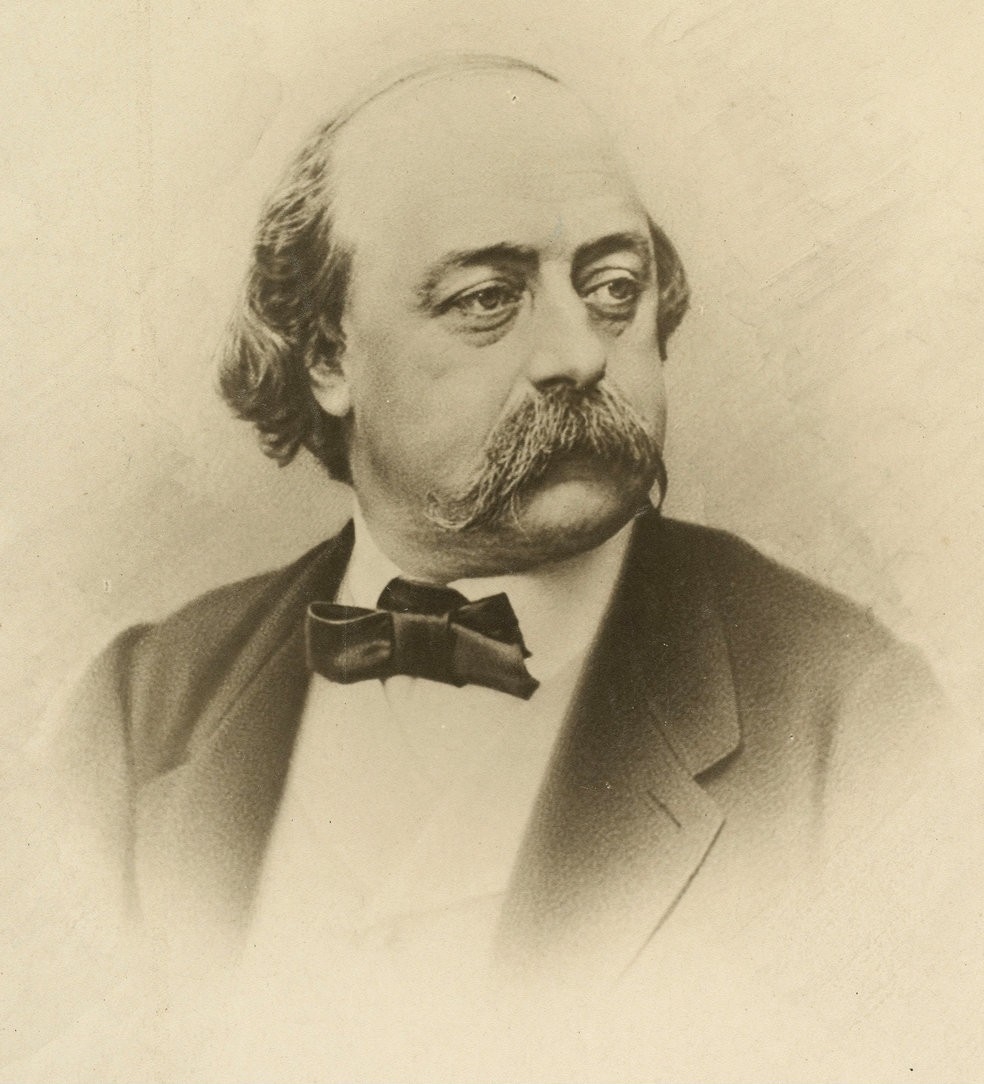
Today I finished reading Madame Bovary by celebrated grump and mustache enthusiast Gustave Flaubert. The first sentence is as follows:
"We were in class when the headmaster came in, followed by a new boy, not wearing the school uniform, and a school servant carrying a large desk.”
The last sentence is as follows:
"He has just been given the Croix de la Legion d'Honneur."
The title, of course, is Madame Bovary. According to something I read a long time ago and don't remember, at one point Flaubert was once asked who provided the inspiration for his titular heroine, and bellowed back "Madame Bovary, c'est moi!" And in addition to channeling her creator and naming her text, Emma indeed is the reason for the book: she and her dalliances provide the plotting through which Flaubert channels the scathing things he has to say about bourgeois philistines, especially the pathetic Charles (the new boy from the first sentence) and the worthless pharmacist Homais (the "he" from the final sentence). For such a dominant personality, though, it seems, to my currently-occupied-with-textual-privilege eye, curious that those framing sentences have nothing to do with the titular Madame. (It's also interesting, though I'm not sure why, that the "we" making observations in the first sentence and chapter drops out and never appears again; its as though the novel is a insanely psychologically acute "Where Are Your Classmates?" from the Tostes Yearbook.)
Compare this treatment to that of another Emma. Ms. Woodhouse is introduced like this:
"Emma Woodhouse, handsome, clever, and rich, with a comfortable home and a happy disposition, seemed to unite some of the best blessings of existence; and had lived nearly twenty-one years in the world with very little to distress or vex her."
So here we know we are getting a book that wants to know: what is Emma Woodhouse like? Presumably she will be interesting enough that she will care (though Jane Austen thought no one would like her), and hopefully, for plot's sake, at least something will distress or vex her. But the big difference that I am angling at between this two novels, and using my hokey first-and-last-sentences-as-thematic-indices tool for since this is a blog and not a paper, is that one is focused on a review of a system and one the review of a person. Since I work at Borders, and have a family which is large and largely uninterested in what they call "books you have to think about", I spend a lot of my time wondering what kind of generic difference that makes for: what makes the sort of book that I would like and that my boss would instruct me to leave off of a display, since no one would buy it? Or, what kind of book would I love that my mother would refuse to put before her book club? This structural exercise has opened a set that seems potentially potent, the systems review vs. individual idea. I will sit down with some Sophie Kinsella, a book which my family and Borders customers seem to love (and about which, I swear, I have no opinion yet whatever) and see where she falls between these Emma poles.
Up next: I am not yet done with Grendel, so may you all. So I will probably write another post on him in the next day or two (plus I thought up of a line about him that is too, too good not to post).
Also -- did you know that if you stay up til midnight, you can read what feels like the next day's op-eds? And that Monday is a Krugman day? Kickass.
Today I finished reading Madame Bovary by celebrated grump and mustache enthusiast Gustave Flaubert. The first sentence is as follows:
"We were in class when the headmaster came in, followed by a new boy, not wearing the school uniform, and a school servant carrying a large desk.”
The last sentence is as follows:
"He has just been given the Croix de la Legion d'Honneur."
The title, of course, is Madame Bovary. According to something I read a long time ago and don't remember, at one point Flaubert was once asked who provided the inspiration for his titular heroine, and bellowed back "Madame Bovary, c'est moi!" And in addition to channeling her creator and naming her text, Emma indeed is the reason for the book: she and her dalliances provide the plotting through which Flaubert channels the scathing things he has to say about bourgeois philistines, especially the pathetic Charles (the new boy from the first sentence) and the worthless pharmacist Homais (the "he" from the final sentence). For such a dominant personality, though, it seems, to my currently-occupied-with-textual-privilege eye, curious that those framing sentences have nothing to do with the titular Madame. (It's also interesting, though I'm not sure why, that the "we" making observations in the first sentence and chapter drops out and never appears again; its as though the novel is a insanely psychologically acute "Where Are Your Classmates?" from the Tostes Yearbook.)
Compare this treatment to that of another Emma. Ms. Woodhouse is introduced like this:
"Emma Woodhouse, handsome, clever, and rich, with a comfortable home and a happy disposition, seemed to unite some of the best blessings of existence; and had lived nearly twenty-one years in the world with very little to distress or vex her."
So here we know we are getting a book that wants to know: what is Emma Woodhouse like? Presumably she will be interesting enough that she will care (though Jane Austen thought no one would like her), and hopefully, for plot's sake, at least something will distress or vex her. But the big difference that I am angling at between this two novels, and using my hokey first-and-last-sentences-as-thematic-indices tool for since this is a blog and not a paper, is that one is focused on a review of a system and one the review of a person. Since I work at Borders, and have a family which is large and largely uninterested in what they call "books you have to think about", I spend a lot of my time wondering what kind of generic difference that makes for: what makes the sort of book that I would like and that my boss would instruct me to leave off of a display, since no one would buy it? Or, what kind of book would I love that my mother would refuse to put before her book club? This structural exercise has opened a set that seems potentially potent, the systems review vs. individual idea. I will sit down with some Sophie Kinsella, a book which my family and Borders customers seem to love (and about which, I swear, I have no opinion yet whatever) and see where she falls between these Emma poles.
Up next: I am not yet done with Grendel, so may you all. So I will probably write another post on him in the next day or two (plus I thought up of a line about him that is too, too good not to post).
Also -- did you know that if you stay up til midnight, you can read what feels like the next day's op-eds? And that Monday is a Krugman day? Kickass.
Wednesday, March 26, 2008
Democracy
So here's what I've been reading, in the doldrums surrounding our next official pick: Blake Emerson's tremendous (and recommended) Radical Negative blog, ESPN.com. Madame Bovary, and The Best American Nonrequired Reading 2007. The things most germane to our nominal concerns are the two latter, and the most strongly recommended are the two former (especially Blake's). But for the second two, which I've been studiously devoting myself to on breaks in my strenuous sched at Borders: what's going on with Mme B.? Why do so many novel-historians think it's so important? And what's going on with the BANRR2007? What are the new and hip reading these days?
The first thing I'd like to recommend about one of these is the BANRR's newly acquired habit of pointing out the Best American First Sentences of Novels. This practice is absolutely irreplaceable. And the best part is, you can do it yourself. Go to Borders or wherever, and just write down like ten or twenty first sentences of novels, picked at random. Throw in a short story or a biography if you want, just make sure that it's the first thing the author wanted you to see. And look at them. This is a specially privileged piece of text that you'll be privileging yourself to, right up there with writing down instances of a book's title in its text (which is harder to find and, frankly, as a generic exercise, less rewarding). Think about it -- this is the equivalent of inviting yourself to the ESPYs, or some other party for the privileged. Look at the text that is most special! This is almost as good as inviting yourself to a party for the OTHER most privileged text, the text that gets the honorable job of closing out a novel or story, but minus all the resonant jobs given to them. I seriously recommend this activity, especially if you are put in a bookstore and tasked with the job of "making the place look good" in the final three hours of the night that the store is open.
Anyway, that is enough fun to have for one day. I have Thursday off, so e-mail me your favorite first sentences discovered this way and I will do likewise. Or else, I will post my favorites in the absence of e-mails, or else I will just blog about Madame Bovary. Up to you guys. Democracy in blogs?
YES WE CAN!
The first thing I'd like to recommend about one of these is the BANRR's newly acquired habit of pointing out the Best American First Sentences of Novels. This practice is absolutely irreplaceable. And the best part is, you can do it yourself. Go to Borders or wherever, and just write down like ten or twenty first sentences of novels, picked at random. Throw in a short story or a biography if you want, just make sure that it's the first thing the author wanted you to see. And look at them. This is a specially privileged piece of text that you'll be privileging yourself to, right up there with writing down instances of a book's title in its text (which is harder to find and, frankly, as a generic exercise, less rewarding). Think about it -- this is the equivalent of inviting yourself to the ESPYs, or some other party for the privileged. Look at the text that is most special! This is almost as good as inviting yourself to a party for the OTHER most privileged text, the text that gets the honorable job of closing out a novel or story, but minus all the resonant jobs given to them. I seriously recommend this activity, especially if you are put in a bookstore and tasked with the job of "making the place look good" in the final three hours of the night that the store is open.
Anyway, that is enough fun to have for one day. I have Thursday off, so e-mail me your favorite first sentences discovered this way and I will do likewise. Or else, I will post my favorites in the absence of e-mails, or else I will just blog about Madame Bovary. Up to you guys. Democracy in blogs?
YES WE CAN!
Friday, March 21, 2008
Misty Monster Hop
Here, and at long g.d. last, is the Book Report on Grendel, from me rather than Grendel’s poor patron, but unbowed nevertheless. Where does Grendel fit in on the storied number line of book club book appropriateness? It is hard to say. What Grendel is is a barrage of observation, gleaned in various ways, about selves. But the bookishness of those selves, and the seriousness with which we are advised to take the book-like quality of any self, is chimerical throughout the book. It seems to think different things at different times, or even be different times. Which, well and good if you are a novel narrated for a monster. Not for nothing is their purview called cryptozoology.
I often get on the subject of things that came first and command our respect as such. The whole lame tideover bit that constituted the last entry on this engine was such a getting on of a subject, and conveyed what I normally think about these things: with apologies to Robert Johnson, I’d rather take the new and exciting. However, usually when I am at bars and talking about Chaucer (so like eighty percent of the times I am at bars) I will start admiring Chaucer and Shakespeare and other early heroes for their visionary empathetic abilities. Here’s Sir Philip Sidney, on Chaucer: “I know not whether to marvel more, either that he in that misty time could see so clearly, or that we in this clear age walk so stumblingly after him.” It is a good kind of marvel, that: it is ennobling to imagine mist-surrounded early empathetic pioneers. The problem is that there are a lot more people like William Langland, whose Piers Plowman doesn’t have the same kind of dry-ice cache as the Canterbury Tales, than there are people like the singular Chaucer. So how do you solve a problem like this? One way, is massive, monstrous, pomo anachronism; and so here we have Grendel, rent from his proper, Beowulf-poet-thuddingly dull ways of thinking, and given to talk like he went to Yale in the seventies. That dragon, I guess, is Paul de Man.
How would this book have worked if it wasn’t called Grendel, if it didn’t have Beowulf propping it up? Everyone’s fond of those misty figures, even if they aren’t familiar, and there’s not a lot to Grendel in the source material, so Gardner has plenty of latitude. The parts of the novel that work best in relation to Beowulf are the ones that echo with irony – we know well before our narrator what fate awaits him at the hands of that Geat he never gets around to naming. And his analysis of the power of fiction is very shrewd – Grendel is most interesting when he talks about the Shaper, who had “changed the world, had torn up the past by its thick, gnarled roots and had transmuted it, and [the Danes] who knew the truth, remembered it his way – and so did I” (Gardner, 43). One avenue that seemed, at first, to be one that may have been interestingly explored, would’ve been an awareness, or even a suggestion, on Grendel’s part that he was no less invented than the harmonious reign of Scyld. However, the more I think of it, that would’ve been to absolutely kick down the pole that held up the tent, and I am glad that Gardner held off. In fact, the huge importance given the Shaper seems to suggest that he may have at one time thought of such a gesture, but that the rich character of his invented, sorrowful Grendel – sad, sardonic, scourging – refused to sabotage himself.
Up next: I haven’t decided. I am vacillating between our Shadow Correspondent’s suggestion (Proust was a Neuroscientist, which I really want to read but kind of want to read Swann’s Way first) and one of my own personal current intrigue, Author Author by David Lodge (starring a fictionalized Henry James). That, or I’m going to inaugurate a new series where I only read books that have been recommended to me, and then try to judge the character of the recommender by their pick. Stay tuned!
I often get on the subject of things that came first and command our respect as such. The whole lame tideover bit that constituted the last entry on this engine was such a getting on of a subject, and conveyed what I normally think about these things: with apologies to Robert Johnson, I’d rather take the new and exciting. However, usually when I am at bars and talking about Chaucer (so like eighty percent of the times I am at bars) I will start admiring Chaucer and Shakespeare and other early heroes for their visionary empathetic abilities. Here’s Sir Philip Sidney, on Chaucer: “I know not whether to marvel more, either that he in that misty time could see so clearly, or that we in this clear age walk so stumblingly after him.” It is a good kind of marvel, that: it is ennobling to imagine mist-surrounded early empathetic pioneers. The problem is that there are a lot more people like William Langland, whose Piers Plowman doesn’t have the same kind of dry-ice cache as the Canterbury Tales, than there are people like the singular Chaucer. So how do you solve a problem like this? One way, is massive, monstrous, pomo anachronism; and so here we have Grendel, rent from his proper, Beowulf-poet-thuddingly dull ways of thinking, and given to talk like he went to Yale in the seventies. That dragon, I guess, is Paul de Man.
How would this book have worked if it wasn’t called Grendel, if it didn’t have Beowulf propping it up? Everyone’s fond of those misty figures, even if they aren’t familiar, and there’s not a lot to Grendel in the source material, so Gardner has plenty of latitude. The parts of the novel that work best in relation to Beowulf are the ones that echo with irony – we know well before our narrator what fate awaits him at the hands of that Geat he never gets around to naming. And his analysis of the power of fiction is very shrewd – Grendel is most interesting when he talks about the Shaper, who had “changed the world, had torn up the past by its thick, gnarled roots and had transmuted it, and [the Danes] who knew the truth, remembered it his way – and so did I” (Gardner, 43). One avenue that seemed, at first, to be one that may have been interestingly explored, would’ve been an awareness, or even a suggestion, on Grendel’s part that he was no less invented than the harmonious reign of Scyld. However, the more I think of it, that would’ve been to absolutely kick down the pole that held up the tent, and I am glad that Gardner held off. In fact, the huge importance given the Shaper seems to suggest that he may have at one time thought of such a gesture, but that the rich character of his invented, sorrowful Grendel – sad, sardonic, scourging – refused to sabotage himself.
Up next: I haven’t decided. I am vacillating between our Shadow Correspondent’s suggestion (Proust was a Neuroscientist, which I really want to read but kind of want to read Swann’s Way first) and one of my own personal current intrigue, Author Author by David Lodge (starring a fictionalized Henry James). That, or I’m going to inaugurate a new series where I only read books that have been recommended to me, and then try to judge the character of the recommender by their pick. Stay tuned!
Subscribe to:
Posts (Atom)