On bookslut today, I found a list from the American Book Review that seemed to me to be of a piece, interest wise, with the most recent thoughts posted by this outfit, vis a vis privileged chunks of text. Some of them are interested in their ideas about what a last line really is (the BANRR is more strict about sentences); their numbers one and four, for example, come from weirdly punctuated texts, and to throw the whole sentence up would be pdf-straining. The other chunk of special text, in addition to these prides of place, is the title, and today I want to talk about those three things working in conjunction, mostly because I still haven't picked out the book that will be this outfit's next selection. Hopefully, that will change by the end of the post.
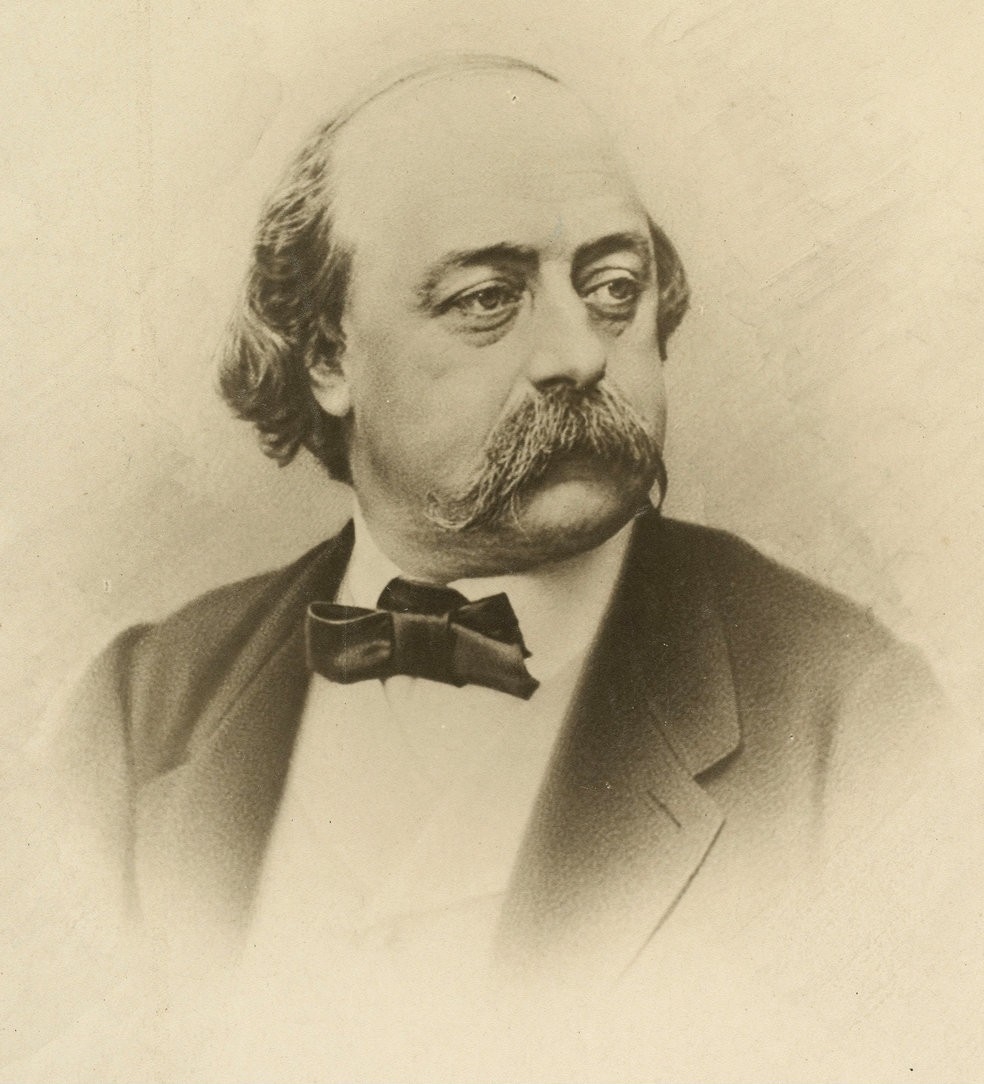
Today I finished reading Madame Bovary by celebrated grump and mustache enthusiast Gustave Flaubert. The first sentence is as follows:
"We were in class when the headmaster came in, followed by a new boy, not wearing the school uniform, and a school servant carrying a large desk.”
The last sentence is as follows:
"He has just been given the Croix de la Legion d'Honneur."
The title, of course, is Madame Bovary. According to something I read a long time ago and don't remember, at one point Flaubert was once asked who provided the inspiration for his titular heroine, and bellowed back "Madame Bovary, c'est moi!" And in addition to channeling her creator and naming her text, Emma indeed is the reason for the book: she and her dalliances provide the plotting through which Flaubert channels the scathing things he has to say about bourgeois philistines, especially the pathetic Charles (the new boy from the first sentence) and the worthless pharmacist Homais (the "he" from the final sentence). For such a dominant personality, though, it seems, to my currently-occupied-with-textual-privilege eye, curious that those framing sentences have nothing to do with the titular Madame. (It's also interesting, though I'm not sure why, that the "we" making observations in the first sentence and chapter drops out and never appears again; its as though the novel is a insanely psychologically acute "Where Are Your Classmates?" from the Tostes Yearbook.)
Compare this treatment to that of another Emma. Ms. Woodhouse is introduced like this:
"Emma Woodhouse, handsome, clever, and rich, with a comfortable home and a happy disposition, seemed to unite some of the best blessings of existence; and had lived nearly twenty-one years in the world with very little to distress or vex her."
So here we know we are getting a book that wants to know: what is Emma Woodhouse like? Presumably she will be interesting enough that she will care (though Jane Austen thought no one would like her), and hopefully, for plot's sake, at least something will distress or vex her. But the big difference that I am angling at between this two novels, and using my hokey first-and-last-sentences-as-thematic-indices tool for since this is a blog and not a paper, is that one is focused on a review of a system and one the review of a person. Since I work at Borders, and have a family which is large and largely uninterested in what they call "books you have to think about", I spend a lot of my time wondering what kind of generic difference that makes for: what makes the sort of book that I would like and that my boss would instruct me to leave off of a display, since no one would buy it? Or, what kind of book would I love that my mother would refuse to put before her book club? This structural exercise has opened a set that seems potentially potent, the systems review vs. individual idea. I will sit down with some Sophie Kinsella, a book which my family and Borders customers seem to love (and about which, I swear, I have no opinion yet whatever) and see where she falls between these Emma poles.
Up next: I am not yet done with Grendel, so may you all. So I will probably write another post on him in the next day or two (plus I thought up of a line about him that is too, too good not to post).
Also -- did you know that if you stay up til midnight, you can read what feels like the next day's op-eds? And that Monday is a Krugman day? Kickass.
Sunday, March 30, 2008

Wednesday, March 26, 2008
Democracy
So here's what I've been reading, in the doldrums surrounding our next official pick: Blake Emerson's tremendous (and recommended) Radical Negative blog, ESPN.com. Madame Bovary, and The Best American Nonrequired Reading 2007. The things most germane to our nominal concerns are the two latter, and the most strongly recommended are the two former (especially Blake's). But for the second two, which I've been studiously devoting myself to on breaks in my strenuous sched at Borders: what's going on with Mme B.? Why do so many novel-historians think it's so important? And what's going on with the BANRR2007? What are the new and hip reading these days?
The first thing I'd like to recommend about one of these is the BANRR's newly acquired habit of pointing out the Best American First Sentences of Novels. This practice is absolutely irreplaceable. And the best part is, you can do it yourself. Go to Borders or wherever, and just write down like ten or twenty first sentences of novels, picked at random. Throw in a short story or a biography if you want, just make sure that it's the first thing the author wanted you to see. And look at them. This is a specially privileged piece of text that you'll be privileging yourself to, right up there with writing down instances of a book's title in its text (which is harder to find and, frankly, as a generic exercise, less rewarding). Think about it -- this is the equivalent of inviting yourself to the ESPYs, or some other party for the privileged. Look at the text that is most special! This is almost as good as inviting yourself to a party for the OTHER most privileged text, the text that gets the honorable job of closing out a novel or story, but minus all the resonant jobs given to them. I seriously recommend this activity, especially if you are put in a bookstore and tasked with the job of "making the place look good" in the final three hours of the night that the store is open.
Anyway, that is enough fun to have for one day. I have Thursday off, so e-mail me your favorite first sentences discovered this way and I will do likewise. Or else, I will post my favorites in the absence of e-mails, or else I will just blog about Madame Bovary. Up to you guys. Democracy in blogs?
YES WE CAN!
The first thing I'd like to recommend about one of these is the BANRR's newly acquired habit of pointing out the Best American First Sentences of Novels. This practice is absolutely irreplaceable. And the best part is, you can do it yourself. Go to Borders or wherever, and just write down like ten or twenty first sentences of novels, picked at random. Throw in a short story or a biography if you want, just make sure that it's the first thing the author wanted you to see. And look at them. This is a specially privileged piece of text that you'll be privileging yourself to, right up there with writing down instances of a book's title in its text (which is harder to find and, frankly, as a generic exercise, less rewarding). Think about it -- this is the equivalent of inviting yourself to the ESPYs, or some other party for the privileged. Look at the text that is most special! This is almost as good as inviting yourself to a party for the OTHER most privileged text, the text that gets the honorable job of closing out a novel or story, but minus all the resonant jobs given to them. I seriously recommend this activity, especially if you are put in a bookstore and tasked with the job of "making the place look good" in the final three hours of the night that the store is open.
Anyway, that is enough fun to have for one day. I have Thursday off, so e-mail me your favorite first sentences discovered this way and I will do likewise. Or else, I will post my favorites in the absence of e-mails, or else I will just blog about Madame Bovary. Up to you guys. Democracy in blogs?
YES WE CAN!
Friday, March 21, 2008
Misty Monster Hop
Here, and at long g.d. last, is the Book Report on Grendel, from me rather than Grendel’s poor patron, but unbowed nevertheless. Where does Grendel fit in on the storied number line of book club book appropriateness? It is hard to say. What Grendel is is a barrage of observation, gleaned in various ways, about selves. But the bookishness of those selves, and the seriousness with which we are advised to take the book-like quality of any self, is chimerical throughout the book. It seems to think different things at different times, or even be different times. Which, well and good if you are a novel narrated for a monster. Not for nothing is their purview called cryptozoology.
I often get on the subject of things that came first and command our respect as such. The whole lame tideover bit that constituted the last entry on this engine was such a getting on of a subject, and conveyed what I normally think about these things: with apologies to Robert Johnson, I’d rather take the new and exciting. However, usually when I am at bars and talking about Chaucer (so like eighty percent of the times I am at bars) I will start admiring Chaucer and Shakespeare and other early heroes for their visionary empathetic abilities. Here’s Sir Philip Sidney, on Chaucer: “I know not whether to marvel more, either that he in that misty time could see so clearly, or that we in this clear age walk so stumblingly after him.” It is a good kind of marvel, that: it is ennobling to imagine mist-surrounded early empathetic pioneers. The problem is that there are a lot more people like William Langland, whose Piers Plowman doesn’t have the same kind of dry-ice cache as the Canterbury Tales, than there are people like the singular Chaucer. So how do you solve a problem like this? One way, is massive, monstrous, pomo anachronism; and so here we have Grendel, rent from his proper, Beowulf-poet-thuddingly dull ways of thinking, and given to talk like he went to Yale in the seventies. That dragon, I guess, is Paul de Man.
How would this book have worked if it wasn’t called Grendel, if it didn’t have Beowulf propping it up? Everyone’s fond of those misty figures, even if they aren’t familiar, and there’s not a lot to Grendel in the source material, so Gardner has plenty of latitude. The parts of the novel that work best in relation to Beowulf are the ones that echo with irony – we know well before our narrator what fate awaits him at the hands of that Geat he never gets around to naming. And his analysis of the power of fiction is very shrewd – Grendel is most interesting when he talks about the Shaper, who had “changed the world, had torn up the past by its thick, gnarled roots and had transmuted it, and [the Danes] who knew the truth, remembered it his way – and so did I” (Gardner, 43). One avenue that seemed, at first, to be one that may have been interestingly explored, would’ve been an awareness, or even a suggestion, on Grendel’s part that he was no less invented than the harmonious reign of Scyld. However, the more I think of it, that would’ve been to absolutely kick down the pole that held up the tent, and I am glad that Gardner held off. In fact, the huge importance given the Shaper seems to suggest that he may have at one time thought of such a gesture, but that the rich character of his invented, sorrowful Grendel – sad, sardonic, scourging – refused to sabotage himself.
Up next: I haven’t decided. I am vacillating between our Shadow Correspondent’s suggestion (Proust was a Neuroscientist, which I really want to read but kind of want to read Swann’s Way first) and one of my own personal current intrigue, Author Author by David Lodge (starring a fictionalized Henry James). That, or I’m going to inaugurate a new series where I only read books that have been recommended to me, and then try to judge the character of the recommender by their pick. Stay tuned!
I often get on the subject of things that came first and command our respect as such. The whole lame tideover bit that constituted the last entry on this engine was such a getting on of a subject, and conveyed what I normally think about these things: with apologies to Robert Johnson, I’d rather take the new and exciting. However, usually when I am at bars and talking about Chaucer (so like eighty percent of the times I am at bars) I will start admiring Chaucer and Shakespeare and other early heroes for their visionary empathetic abilities. Here’s Sir Philip Sidney, on Chaucer: “I know not whether to marvel more, either that he in that misty time could see so clearly, or that we in this clear age walk so stumblingly after him.” It is a good kind of marvel, that: it is ennobling to imagine mist-surrounded early empathetic pioneers. The problem is that there are a lot more people like William Langland, whose Piers Plowman doesn’t have the same kind of dry-ice cache as the Canterbury Tales, than there are people like the singular Chaucer. So how do you solve a problem like this? One way, is massive, monstrous, pomo anachronism; and so here we have Grendel, rent from his proper, Beowulf-poet-thuddingly dull ways of thinking, and given to talk like he went to Yale in the seventies. That dragon, I guess, is Paul de Man.
How would this book have worked if it wasn’t called Grendel, if it didn’t have Beowulf propping it up? Everyone’s fond of those misty figures, even if they aren’t familiar, and there’s not a lot to Grendel in the source material, so Gardner has plenty of latitude. The parts of the novel that work best in relation to Beowulf are the ones that echo with irony – we know well before our narrator what fate awaits him at the hands of that Geat he never gets around to naming. And his analysis of the power of fiction is very shrewd – Grendel is most interesting when he talks about the Shaper, who had “changed the world, had torn up the past by its thick, gnarled roots and had transmuted it, and [the Danes] who knew the truth, remembered it his way – and so did I” (Gardner, 43). One avenue that seemed, at first, to be one that may have been interestingly explored, would’ve been an awareness, or even a suggestion, on Grendel’s part that he was no less invented than the harmonious reign of Scyld. However, the more I think of it, that would’ve been to absolutely kick down the pole that held up the tent, and I am glad that Gardner held off. In fact, the huge importance given the Shaper seems to suggest that he may have at one time thought of such a gesture, but that the rich character of his invented, sorrowful Grendel – sad, sardonic, scourging – refused to sabotage himself.
Up next: I haven’t decided. I am vacillating between our Shadow Correspondent’s suggestion (Proust was a Neuroscientist, which I really want to read but kind of want to read Swann’s Way first) and one of my own personal current intrigue, Author Author by David Lodge (starring a fictionalized Henry James). That, or I’m going to inaugurate a new series where I only read books that have been recommended to me, and then try to judge the character of the recommender by their pick. Stay tuned!
Monday, February 25, 2008
Hiatus Update
Great news everyone, I am posting again. I am sorry for the delay, and sorrier to announce that I don't even have anything to say about new selection Grendel, beyond the fact that I just read a different book by John Gardner (the manifestoey The Art of Fiction) and another book directly pertinent to Our Selection (the Beowulf translated by Seamus Heaney). Also, I went to the scene of the crime itself, England, only to find out, while reading on the airplane, that though Beowulf was written in English, it takes place in Denmark and in Geatland. Who knew! But a few things about Beowulf before starting in on Grendel. One of the things I noticed about it, was that, like Aeschylus and Sophocles, I thought it was kind of boring. I think this is because it is so old that no one had to do anything even remotely interesting to make it worth writing down. Just like how everyone cares about your first word and not your millionth, the fact that the first story like Beowulf even was made it noteworthy. Now, I ask you -- does that make it worth reading still? Everyone says you should like the blues and bands like Orange Juice, because without them there wouldn't be bands like the Kinks or the National. I do not say this. I think it is silly. But it seems as if for things like Beowulf and ancient Greek plays (I'm excluding Homer, because his epics seem to me to have enough plot to be interesting, rather than just being examinations of emotions -- rage, pride, woe -- that are broad enough to now be stock) are, through a function maybe of literature's being totally obsessed with itself, important to at least sort of understand. For future reference purposes, at least -- to appreciate, for example, Grendel by John Gardner, or Les Mouches (which I really liked) by Sartre. I don't know if that's good or bad -- that so many books gain resonance through reminding us of old things -- but it does seem worth pointing out, at least when I have been totally slacking on saying anything on here. Also, one last note on the above comparison between pop music and literature -- pop music seems to be, for the most part, unliterarily unconcerned with its own past (there are vaguely deconstructionist bands like Art Brut and Pavement, but leave that kind of influence-spotting to critics, who love to do it). It is unlike, in this respect, classical music (as I understand it from Alex Ross's the Rest is Noise, which is very informative about the tendency of composers at least since the fin-de-siecle to quote from each other liberally) and especially rap music, which is constantly about rap music. Again, I don't know quite what to make of this -- the observation that fiction is more like classical or rap music than pop music -- but, on an off month, there it is. Soon in the week -- a post on Grendel, more on why I found Beowulf boring, and, if we pray hard to the bloggods, maybe a post from Brian Blood on what he thought of his handsome edition of Atonement.
Tuesday, February 5, 2008
it's at least better than the road
i'm sure that we can all agree that among many fundamental differences between the two books which we have read thus far is the fact that atonement lends itself to a much greater extent to reading for pleasure, at least for those who would rather fantasize about bourgeois life in england than about being the last remaining symbol of human decency in a barren, post-apocalyptic wasteland. however, i thoroughly believe that, in addition to its greater entertainment value, atonement surpasses the road as an all-around literary and intellectual achievement, mostly because of the much greater maturity McEwan shows as a writer.
the book opens with an account of briony's creative process, in which she seeks to produce a work which will "inspire not laughter, but terror, relief, and instruction, in that order" (mcewan 8). in all her naivete, she assumes that as an author she is obligated to assert, without question, her intellectual superiority over her audience. her work must be impersonal, as any form of self-acknowledgment contained within is likely to portray her as human, and thus as fallible and questionable in whatever epic moral prophesy she wishes to impose on her readers. for me, this immediately brought mccarthy to mind. though it's not to say i didn't enjoy the road or respect him as an author, i do think he was, at least in the road, to some extent restricted by briony's same childish persistence in thinking that previously established standards of literature have created in writers an obligation to impersonality, lest they be deemed flawed as actual, non-writing human beings. even through the boy does mccarthy decline the opportunity to express the vestiges of his youthful ignorance, and the result is insight which, though often philisophically intruiging, is hard to believe to have come from such a young mind. the characters in atonement i find much more believable, and in most cases it is because mcewan is not afraid to imbue them with the flaws that he knows they must have, because he surely finds in himself, even as a writer. we identify with briony's creative struggles because we know that mcewan does too; we believe what we are reading because we know that the person telling it to us does not consider himself, even in the context of his own story, to be infallible or omnipotent.
unlike briony, at least at the book's beginning, mcewan is not afraid to inspire laughter, or any other indication of the emotions which we are often afraid to admit that we feel. this sort of emotional appeal seems to be what mcewan values most in the literary craft, and he therefore places the establishment of absolute artistic superiority, seemingly adored by both briony and mccarthy, further down, if anywhere, on his list of priorities. perhaps Cecelia's insistence that the flowers be arranged with perfect imperfection is symbolic, but at no point does he shove it down our throats. yet with painfully contrived lines like, "Who is it? said the boy. I don't know. Who is anybody?" mccarthy seems much less conscious of the merits of artistic subtlety.
the book opens with an account of briony's creative process, in which she seeks to produce a work which will "inspire not laughter, but terror, relief, and instruction, in that order" (mcewan 8). in all her naivete, she assumes that as an author she is obligated to assert, without question, her intellectual superiority over her audience. her work must be impersonal, as any form of self-acknowledgment contained within is likely to portray her as human, and thus as fallible and questionable in whatever epic moral prophesy she wishes to impose on her readers. for me, this immediately brought mccarthy to mind. though it's not to say i didn't enjoy the road or respect him as an author, i do think he was, at least in the road, to some extent restricted by briony's same childish persistence in thinking that previously established standards of literature have created in writers an obligation to impersonality, lest they be deemed flawed as actual, non-writing human beings. even through the boy does mccarthy decline the opportunity to express the vestiges of his youthful ignorance, and the result is insight which, though often philisophically intruiging, is hard to believe to have come from such a young mind. the characters in atonement i find much more believable, and in most cases it is because mcewan is not afraid to imbue them with the flaws that he knows they must have, because he surely finds in himself, even as a writer. we identify with briony's creative struggles because we know that mcewan does too; we believe what we are reading because we know that the person telling it to us does not consider himself, even in the context of his own story, to be infallible or omnipotent.
unlike briony, at least at the book's beginning, mcewan is not afraid to inspire laughter, or any other indication of the emotions which we are often afraid to admit that we feel. this sort of emotional appeal seems to be what mcewan values most in the literary craft, and he therefore places the establishment of absolute artistic superiority, seemingly adored by both briony and mccarthy, further down, if anywhere, on his list of priorities. perhaps Cecelia's insistence that the flowers be arranged with perfect imperfection is symbolic, but at no point does he shove it down our throats. yet with painfully contrived lines like, "Who is it? said the boy. I don't know. Who is anybody?" mccarthy seems much less conscious of the merits of artistic subtlety.
Monday, February 4, 2008
Why I am Not a Novelist; or, Epigrams Revisited
So. This is why I am not a novelist: whenever I come up with an idea that I like, usually spend between seven and eight hundred words teasing it out into some form that, when you squint at it, kind of makes sense. And then, invariably, I read something by a novelist (or poet, or lyricist -- this one's pretty broad) in the ensuing days that says whatever I wanted to say 900 times more clearly. So, apropos of the benefits of textually constructed people (painting with a broad brush, Brionys) relative to personality constructed people (Cecelia, you, me, everyone we know), here is Proust, from Lydia Davis's translation of Swann's Way, on novelists:
"These were the events taking place in the book I was reading; it is true that the people affected by them were not 'real,' as Francoise said. But all the feelings we are made to experience by the joy or misfortune of a real person are produced in us only through the intermediary of an image of that joy or that misfortune; the ingeniousness of the first novelist consisted in understanding that in the apparatus of our emotions, the image being the only essential element, the simplification that would consist in purely and simply abolishing real people would be a decisive improvement...The novelist's happy discovery was to have the idea of replacing these [corporeal] parts, impenetrable to the soul, by an equal quantity of immaterial parts, that is to say, parts which our soul can assimilate." (Proust, 86-87)
Fittingly, for Proust, that's way too long for a normal epigram. But, despite its strong claim ("equal quantity of immaterial parts"?), I think it distills the heart of what I was trying to talk about, about the end of Atonement. And since I just read it, it struck me, and now it's out here to strike you too. Happy Grendeling, and I hope to have something soon about the relationship to books had by either my mother's book club or my aunt Molly's solo adventures with the Diving Bell and the Butterfly within the week. Also, though Grendel's been announced, feel free to toss up any more comments on any part of Atonement.
"These were the events taking place in the book I was reading; it is true that the people affected by them were not 'real,' as Francoise said. But all the feelings we are made to experience by the joy or misfortune of a real person are produced in us only through the intermediary of an image of that joy or that misfortune; the ingeniousness of the first novelist consisted in understanding that in the apparatus of our emotions, the image being the only essential element, the simplification that would consist in purely and simply abolishing real people would be a decisive improvement...The novelist's happy discovery was to have the idea of replacing these [corporeal] parts, impenetrable to the soul, by an equal quantity of immaterial parts, that is to say, parts which our soul can assimilate." (Proust, 86-87)
Fittingly, for Proust, that's way too long for a normal epigram. But, despite its strong claim ("equal quantity of immaterial parts"?), I think it distills the heart of what I was trying to talk about, about the end of Atonement. And since I just read it, it struck me, and now it's out here to strike you too. Happy Grendeling, and I hope to have something soon about the relationship to books had by either my mother's book club or my aunt Molly's solo adventures with the Diving Bell and the Butterfly within the week. Also, though Grendel's been announced, feel free to toss up any more comments on any part of Atonement.
Friday, February 1, 2008
Now, Here Is a Book With Which to Start Your Book Club
Two posts in two days! Woohoo! Also, our new pick – the book for February-ish, since we seem to be busting through about a book a month – is at the end.
Anyway, I finished Atonement some time ago, and here are my thoughts on it. Because I can never keep them straight in my head though, first I am going to rehash the kinds of questions I think it is a good idea to consider when finishing a book. Here they are again:
Why would anyone think reading this book is a good way to spend time?
How has the fact that I have read this book impacted the way I will do things from now on?
Now, the easiest ways to answer these questions – and the way I answer them about reading, say, message boards on IMDb – is, they wouldn’t and it won’t. But the second question should be answerable for almost any book (Dr. Johnson said something like that, that there was no book so bad that you couldn’t get something out of it, but I can never find that quote and my papers on Dr. J are in Buffalo, in storage). What can one get out of reading Atonement? More narrowly, and maybe combining the two q’s, What has reading Atonement got me that I couldn’t’ve been given by another book?
One thing it might give you, is a reason to have a book club. Atonement exults in words and wordiness at every conceivable level. There is the multivalent way in which Briony, the writer, exists only in her wordiness – we get her powerful drive to express herself and to achieve meaning through words, in writing this novel, but we also get a debased version of it and a cartoon of it, in her false testimony to Robbie and in her puerile writings like the Trial of Arabella (which cartoon is one of the novel’s purest exultations, with its “hieroglyph”s and “evanesce”s). As I discussed earlier, we get things like the talismanic power of words for Robbie and Cecelia, with their “I will wait for you, come back to me”.
And one of the promises that I think we can find in Atonement is the promise that we can achieve understandings with the other people in this universe, and do it with words. I do not think that we ever really understand Robbie and Cecelia, or rather, we understand them only when they are at their most Briony-like. (The same goes, actually, for Emily, the other character to get major point-of-view duties). This makes sense in the world of the book, since Briony is its putative author and, at the end of the day, the lonely, only person between these words and us. (The “BT London 1999” is a remarkably powerful piece of typography, even without the beautiful epilogue that fleshes it out; it collapses the world of the text suddenly, from a relatively broad and democratic set of characters mediated through an authorial conscious to a radically undemocratic story filtered through two). Robbie and Cecelia, once we know the status of this fiction, are totally closed to us. Consider their moment of passion, again one I mentioned earlier, when the text refuses to spell out the fact that they have each said “I love you”: the text retreats in the face of their intimacy, and strives to become, instead, the sort of thing Our Writer Briony would understand. It is impossible for us to know what Cecelia or Robbie mean when either says “I love you”, and it is usually impossible to know what that means, when someone says it to someone else. It is a fundamentally private declaration, and people are usually fundamentally private entities.
But Robbie is told he is loved by not one, but by two Tallis sisters, and the other one is readily understandable. It comes from the writer Briony, and not only is it presented unelliptically but it is introduced by Briony’s statement that it is obvious. And it is, at that moment, obvious to us, because we know what kind of person young Briony is, because we have read about her in this book. Briony is available to us, because she is the genius of the book. Whatever it is that Robbie and Cecelia have is undoubtedly moving, and it is undoubtedly rare, and it is undoubtedly private. Whatever it is that Briony has – whether it’s when she is juvenilely confessing an imaginary love to Robbie as a ten year old, or it’s when she is racked with dissatisfaction with a world that can offer her no atonement – it is something that we can share with her, because it has been totally transfigured into the words that make up this novel.
“She is beginning to get the full grasp of what she did and what it meant,” says Cecelia of her belatedly penitent sister (McEwan, 199). The promise of a novel like this is that what we do can mean something not just in the sense offered by Cecelia’s letter, but in the sense of the novel of which Cecelia’s letter is a part. Briony’s crime and her need for atonement mean something about people, far broader than her narrow original milieu. She shows the kind of community possibly in reading that seems, when put baldly by people like C.S. Lewis, to be a little naive, and thus, to my way of thinking, the kind of thing an ideally running book club might be. Briony represents the promise of meaning – the liberation, by words and wordiness, from her isolation within her particular small set of experiences. It’s a promise, handily enough, of a broad atonement.
Can’t beat the end-with-the-title trick. Next book: after a lot of soul-searching, I made the decision to bait the Crow with another book that is, arguably, related to recent motion picture history, to wit: John Gardner’s Grendel, a book that tells the Beowulf story from the point of view of Grendel, the monster. Enjoy.
Anyway, I finished Atonement some time ago, and here are my thoughts on it. Because I can never keep them straight in my head though, first I am going to rehash the kinds of questions I think it is a good idea to consider when finishing a book. Here they are again:
Why would anyone think reading this book is a good way to spend time?
How has the fact that I have read this book impacted the way I will do things from now on?
Now, the easiest ways to answer these questions – and the way I answer them about reading, say, message boards on IMDb – is, they wouldn’t and it won’t. But the second question should be answerable for almost any book (Dr. Johnson said something like that, that there was no book so bad that you couldn’t get something out of it, but I can never find that quote and my papers on Dr. J are in Buffalo, in storage). What can one get out of reading Atonement? More narrowly, and maybe combining the two q’s, What has reading Atonement got me that I couldn’t’ve been given by another book?
One thing it might give you, is a reason to have a book club. Atonement exults in words and wordiness at every conceivable level. There is the multivalent way in which Briony, the writer, exists only in her wordiness – we get her powerful drive to express herself and to achieve meaning through words, in writing this novel, but we also get a debased version of it and a cartoon of it, in her false testimony to Robbie and in her puerile writings like the Trial of Arabella (which cartoon is one of the novel’s purest exultations, with its “hieroglyph”s and “evanesce”s). As I discussed earlier, we get things like the talismanic power of words for Robbie and Cecelia, with their “I will wait for you, come back to me”.
And one of the promises that I think we can find in Atonement is the promise that we can achieve understandings with the other people in this universe, and do it with words. I do not think that we ever really understand Robbie and Cecelia, or rather, we understand them only when they are at their most Briony-like. (The same goes, actually, for Emily, the other character to get major point-of-view duties). This makes sense in the world of the book, since Briony is its putative author and, at the end of the day, the lonely, only person between these words and us. (The “BT London 1999” is a remarkably powerful piece of typography, even without the beautiful epilogue that fleshes it out; it collapses the world of the text suddenly, from a relatively broad and democratic set of characters mediated through an authorial conscious to a radically undemocratic story filtered through two). Robbie and Cecelia, once we know the status of this fiction, are totally closed to us. Consider their moment of passion, again one I mentioned earlier, when the text refuses to spell out the fact that they have each said “I love you”: the text retreats in the face of their intimacy, and strives to become, instead, the sort of thing Our Writer Briony would understand. It is impossible for us to know what Cecelia or Robbie mean when either says “I love you”, and it is usually impossible to know what that means, when someone says it to someone else. It is a fundamentally private declaration, and people are usually fundamentally private entities.
But Robbie is told he is loved by not one, but by two Tallis sisters, and the other one is readily understandable. It comes from the writer Briony, and not only is it presented unelliptically but it is introduced by Briony’s statement that it is obvious. And it is, at that moment, obvious to us, because we know what kind of person young Briony is, because we have read about her in this book. Briony is available to us, because she is the genius of the book. Whatever it is that Robbie and Cecelia have is undoubtedly moving, and it is undoubtedly rare, and it is undoubtedly private. Whatever it is that Briony has – whether it’s when she is juvenilely confessing an imaginary love to Robbie as a ten year old, or it’s when she is racked with dissatisfaction with a world that can offer her no atonement – it is something that we can share with her, because it has been totally transfigured into the words that make up this novel.
“She is beginning to get the full grasp of what she did and what it meant,” says Cecelia of her belatedly penitent sister (McEwan, 199). The promise of a novel like this is that what we do can mean something not just in the sense offered by Cecelia’s letter, but in the sense of the novel of which Cecelia’s letter is a part. Briony’s crime and her need for atonement mean something about people, far broader than her narrow original milieu. She shows the kind of community possibly in reading that seems, when put baldly by people like C.S. Lewis, to be a little naive, and thus, to my way of thinking, the kind of thing an ideally running book club might be. Briony represents the promise of meaning – the liberation, by words and wordiness, from her isolation within her particular small set of experiences. It’s a promise, handily enough, of a broad atonement.
Can’t beat the end-with-the-title trick. Next book: after a lot of soul-searching, I made the decision to bait the Crow with another book that is, arguably, related to recent motion picture history, to wit: John Gardner’s Grendel, a book that tells the Beowulf story from the point of view of Grendel, the monster. Enjoy.
Subscribe to:
Posts (Atom)